

Water tank cooler installation in Kuwait is a service Al-Kauther Home Services provides across all six governorates: we inspect your tank, its capacity and position, then fit the right unit for it, whether a tank cooling fan, a blower cooler with a timer, or a compressor chiller with a coil that cools the water from inside. We run safe wiring to it and test it in front of you. Prices start from 54 KWD for a tank fan and from 232 KWD for a compressor chiller. To get in touch, call or WhatsApp us on 65550977 and send a photo of the tank and its size.
In a Kuwaiti summer, water from a rooftop tank comes out of the shower and the tap far too hot to use, and that is more than a comfort problem. It makes washing and wudu difficult at midday and forces families to mix water just to get a bearable temperature. This guide is written for people who want to understand before they pay: which units exist, how each one works, what happens on installation day, what it costs, and why one unit suits a tank while another does not.
In short
- Service: tank survey, choosing the cooler type, installation, wiring, setup and testing, and follow-up after the job.
- Units: tank cooling fan, blower cooler with timer, quiet smart cooler, compressor coil chiller, and solutions for large tanks and pools.
- Prices: tank fan from 54 KWD, blower cooler from 56, smart cooler from 75, compressor chiller from 232 KWD.
- Installation time: about an hour for a fan or blower, 3 to 5 hours for a compressor chiller depending on the cable and pipe runs.
- Coverage: Capital, Hawalli, Farwaniya, Ahmadi, Jahra and Mubarak Al-Kabeer.
- Working hours: daily from 8 am to 10 pm.
- Contact: call or WhatsApp 65550977.
What does tank cooler installation in Kuwait include?
Tank cooler installation in Kuwait covers four stages: surveying the tank on the roof, choosing a unit that matches its capacity and type, installing it with the electrical connection, and finally setting the timer or thermostat, testing the unit and showing you how to run it. We never start with a device and look for a tank to put it on; we start with the tank and choose the unit to fit it.
During the survey we note the capacity in gallons, the material (polyethylene, fiberglass or sectional panels), whether the tank sits in full sun or in shade, how far it is from the nearest power point on the roof, and the condition of the hatch. These details decide whether a fan is enough, whether the tank needs a compressor unit, or whether shading and insulation should come before any device.
- Survey the tank and, where possible, measure the water temperature at peak heat.
- Suggest two or three suitable units with the price and performance difference between them.
- Prepare the hatch, or a base for the outdoor unit, depending on the cooler type.
- Run a dedicated power line with cable in conduit and a protective breaker.
- Set the timer or thermostat and test switching on and off in front of you.
- Follow-up after the job: if an installation fault appears within the agreed period, we come back and fix it.
Why does tank water get almost scalding in a Kuwaiti summer?
Tank water in Kuwait heats up because a rooftop tank takes direct sun for long hours in air that passes 45 to 50°C, so the water inside reaches 55 or 60°C by midday, according to people who work in this trade. Water also holds heat for a long time, so it stays hot for hours after sunset.
Three things make it worse: a dark tank colour that absorbs heat, a tank standing on an open roof with no shade, and exposed metal or plastic pipes running across the roof before they enter the house. That is why two neighbouring houses can have very different water, one bearable and one far too hot; the difference is the tank position and shade, not the tank itself.
Hot water is not only unpleasant in the shower. Over time it strains the pump and plastic plumbing parts, makes mixer taps hard to balance, and stops the family using water normally during the most important hours of the day. Children and elderly people suffer most from a sudden blast of hot shower water.

How do water tank coolers work? Two different ideas
Water tank coolers in Kuwait work in one of two ways. The first is air and evaporation: a fan or blower pushes air across the water surface and expels the hot, humid air. The second is compressor cooling, which pulls heat out of the water itself through a coil carrying refrigerant, exactly like an air conditioner. The first is cheaper and simpler; the second is stronger and more precise.
Air cooling: tank fans and blowers
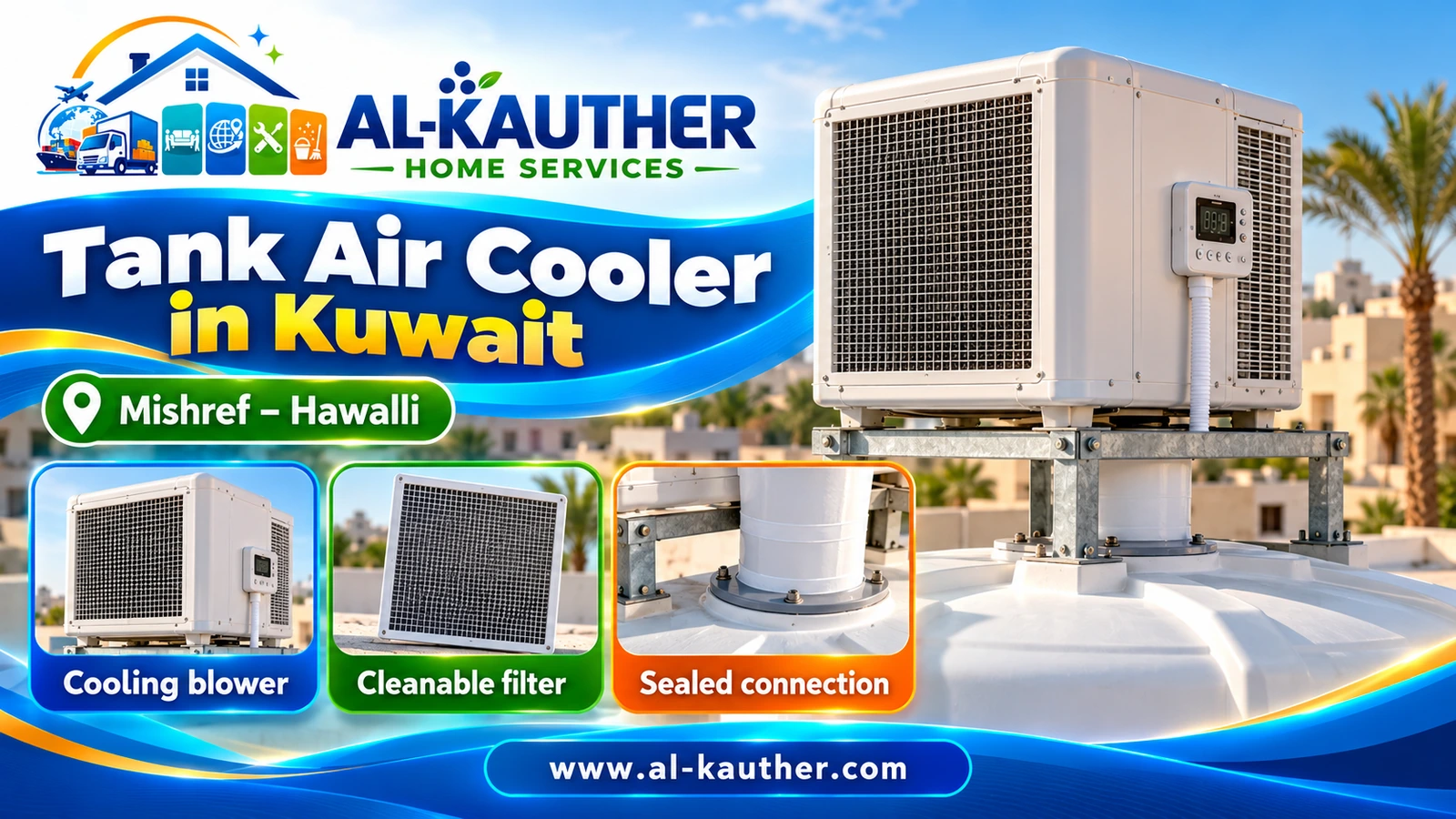
A tank cooling fan is mounted in place of the hatch cover, or on top of it, and pushes filtered air into the empty space above the water. That air picks up water vapour and leaves through a vent covered with mesh, and the evaporation itself draws heat out of the water, so the temperature drops gradually. A blower (dynamo unit) is stronger than a simple fan and moves more air, so it suits larger tanks.
The advantage in Kuwait is that summer air is dry on most days, and dry air evaporates water quickly, so the cooling is noticeable. On very humid days along the coast, especially late in the summer, any evaporative unit performs less well because air already full of moisture cannot easily take more. That is not a fault in the device but the nature of the method; people who live near the sea and want steady results tend to choose a compressor.
Another natural result is that evaporative cooling uses a little water, because part of it leaves as vapour. The float valve tops it up automatically from the mains, so it must be in good order. Makers of units such as Golden Star say they bring the water down to around 22 to 28°C within about four hours, and fan units in general are quoted at around 25 to 30°C.
Compressor cooling: a coil inside the tank and an outdoor unit
A compressor chiller has an outdoor unit that looks like a split AC condenser, a coated copper coil placed inside the tank, a temperature sensor and a digital control panel. Refrigerant circulates through the coil, pulls heat out of the water and releases it through the outdoor unit, and the system stops automatically when the water reaches the temperature you set.
Because it does not depend on dry air, it holds a steady temperature on humid days too. Sellers of the Falcon unit, for example, say it brings water down to 19 or 20°C, and market comparisons say compressor units lower water temperature by 15 to 20 degrees from where it started. Some units come with a long control cable of around 25 metres, so the panel can be placed somewhere easy to reach instead of on the roof.
Technical note: Larger systems and buildings use one of two condenser types: an air-cooled condenser mounted outside the building, which is easier to install, or a water-cooled condenser, which is more efficient and lasts longer but needs more careful design. Industrial chiller plants use reciprocating, screw or centrifugal compressors depending on the load. These details matter for big projects; a house is usually well served by an air-cooled unit.
Types of tank coolers available in Kuwait
Five main types of tank cooler are available in Kuwait: the simple cooling fan, the blower cooler with a timer, the quiet smart cooler, the compressor coil chiller, and solar-powered units, plus circulation systems for large tanks and pools. The table below sums up the practical differences between them, as presented by suppliers and published comparisons in the Kuwaiti market.
| Type | How it works | Expected temperature | Noise | Best for |
|---|---|---|---|---|
| Tank cooling fan | Filtered air and evaporation | About 25–30°C | Low to medium | Small and medium household tanks |
| Blower cooler with timer | Dynamo blower expels hot air | 22–28°C depending on weather | Relatively high | Tanks of 500 to 1,000 gallons |
| Smart cooler with timer | Blower with automatic control and rest cycles | Close to a blower | Very low | Anyone wanting quiet and savings |
| Compressor coil chiller | Refrigerant draws heat out of the water | 19–20°C or as set | Medium (outdoor unit) | Villas, large tanks and humid areas |
| Solar cooler | Fan powered by a solar panel | Weaker than electric on cloudy or dusty days | Low | Roofs far from a power point |
Names you will meet in the Kuwaiti market include Golden Star, Cool Shower and OLX Cool among fans and blowers, Falcon, LG and Wonsa among compressor units, and AquaCooler among smart units. We do not tie you to one brand: we suggest the unit that suits your tank and budget, and we will also fit a unit you bought yourself if it is suitable.
Solar tank cooling fans: are they enough?
A solar tank cooling fan is enough for small tanks on roofs where power is hard to reach, but it is weaker than an electric unit on dusty days because dust covers the panel and cuts its output. Its advantage is that it runs while the sun is out, which is exactly when the tank heats up, and it needs no wiring. If you choose one, plan to wipe the panel after every dust storm.
Tank “air conditioners” and Freon cooling
What people call a “tank air conditioner” or “Freon tank cooling” is the compressor chiller itself: a refrigeration unit that works like an AC but cools water instead of air. The difference from a drinking-water cooler is that a tank unit is built for a large volume of water and uses a corrosion-resistant coil that can stay submerged all the time.
How much does a water tank cooler cost in Kuwait?
At Al-Kauther, a water tank cooler in Kuwait starts from 54 KWD for a tank cooling fan, from 56 KWD for a blower cooler with a timer, from 75 KWD for a quiet smart cooler, and from 232 KWD for a compressor coil chiller. Prices include the unit and standard installation, and change with tank size and the length of the electrical run.
| Unit | Starts from (KWD) | What the price covers |
|---|---|---|
| Tank cooling fan | 54 | The fan, fixing on the hatch, connection to a nearby supply |
| Blower cooler with timer | 56 | The unit, timer, fixing and setting the running hours |
| Quiet smart cooler with timer | 75 | The unit, automatic setup, fixing and testing |
| Compressor coil chiller | 232 | Outdoor unit, coil, sensor, control panel and installation |
| Compressor for large or multiple tanks | After survey | Set by the heat load and number of tanks |
| Servicing or repairing an existing cooler | After survey | Send a photo of the unit and the fault on WhatsApp |
These are starting prices, set after comparing what companies and shops in Kuwait publish, and they sit below those figures. If the electrical run is long, the tank is hard to reach, or the unit needs a special base, the price goes up and we tell you the difference before we start.
What raises or lowers the price of a tank cooler?
- Tank capacity: every extra gallon is more heat to remove, and compressor units are sized in tons.
- Cooling type: evaporative cooling costs far less than a compressor, which contains a compressor, refrigerant and a coil.
- Power use: a more efficient unit may cost more up front and save on the summer bill.
- Brand and after-sales service: spare parts being available in Kuwait matters a lot after two or three years.
- Season: demand peaks at the start of summer; spring installation is easier to schedule.
- Payment: some shops offer instalments over several months on the pricier units.
Before you buy: If someone offers you a “compressor” unit at close to the price of a fan, ask what is inside it: does it really have a compressor, refrigerant and a coil in the tank, or is it a blower under another name? The price gap between the two in Kuwait is large, and published comparisons put compressor units between 250 and 700 KWD.
Not sure which unit suits your tank?
Send a photo of the tank, its size and your area, and we will suggest two options with prices before the visit.
Call 65550977 WhatsAppChoosing a unit by tank size and position
The practical rule in Kuwait: a tank under 500 gallons is well served by a good cooling fan, a tank of 500 to 1,000 gallons suits a blower with a timer or a smart cooler, and larger or multiple tanks, or any tank that needs a steady temperature, suit a compressor. Capacity is not everything, though; the position and material of the tank change the decision.
| Tank size | Suggested solution | Note |
|---|---|---|
| Under 500 gallons | Tank cooling fan | With simple shading the result is excellent |
| 500 – 1,000 gallons | Blower cooler with timer or smart cooler | The most common choice for houses and flats |
| 1,000 – 2,000 gallons | Suitably sized compressor or two blowers | Decided at the survey from the real water temperature |
| Over 2,000 gallons or several tanks | Larger compressor or circulation system | Large villas, apartment buildings and mosques |
| Ground tank | Usually not needed, or cool the line after the pump | The ground shields it from most of the heat |
A rough calculation: why does a large tank need a unit rated in tons?
One ton of refrigeration removes roughly 3.5 kW of heat. A 1,000-gallon tank holds about 4.5 tonnes of water, and lowering it by 15 degrees means removing roughly as much heat as a one-ton unit would handle running for almost a full day, before counting the sun that keeps reheating it. That is why tank compressor units are offered from about 1.5 to 5 tons, and why their price climbs with capacity.
The point is not for you to size the unit yourself, but to understand why a small unit cannot cool a big tank quickly, why we recommend starting a compressor before the peak hours, and why insulation and shade save so much of the unit’s work.
Rooftop tank or ground tank?
It is the rooftop tank that usually needs cooling because it sits in direct sun. A ground tank is protected by soil and concrete and its water is naturally cooler, but the water can heat up on its way from the ground tank to the roof tank through exposed pipes on the walls and roof. In that case, insulating the pipes does more good than a cooler on the ground tank.
Polyethylene or fiberglass tank?
Coolers can be fitted to multi-layer polyethylene tanks, fiberglass tanks and sectional tanks; only the fixing method differs. A polyethylene tank has a round hatch where the fan replaces the lid, while a fiberglass tank may need a dedicated opening for the coil. Insulated multi-layer tanks also keep the water cool for longer after the unit stops, so the cooler runs fewer hours. If your tank is old and cracked, replacing it first makes more sense; see our guide to water tanks for sale in Kuwait.

Installation steps on the day of the visit
Fitting a tank fan or blower usually takes about an hour, and a compressor chiller takes three to five hours depending on the cable and pipe runs and where the outdoor unit goes. These are the steps the technician follows in each case:
Fitting a fan or blower cooler
- Inspect the hatch and lid and make sure the frame is sound and can carry the unit.
- Fix the unit firmly in place of the lid or on top of it, with a seal that keeps out dust and rain.
- Fit the air outlet with fine mesh to keep out insects and birds.
- Run power from the nearest safe point inside protective conduit and fit a weatherproof outdoor isolator.
- Set the timer for the hot hours, for example from mid-morning to evening with rest periods.
- Run a test and check the airflow direction and that air leaves through the vent.
Fitting a compressor coil chiller
- Choose a shaded, well-ventilated spot on the roof for the outdoor unit, away from walls that bounce hot air back into it.
- Mount the unit on a base or stand slightly raised from the roof surface.
- Lower the coil through the tank hatch and fix it so it stays submerged even when the water level drops.
- Place the temperature sensor correctly and run the control panel cable to a convenient spot.
- Connect power on a dedicated line with a breaker sized for the compressor.
- Set the target temperature, start the unit and watch the temperature fall during the first hour.
Advice from the field: Ask the technician to show you where the isolator is, how to switch the unit off and on, and how to change the timer hours. Three minutes of explanation saves you a phone call on the first hot day.
Power and timers: how much electricity does a tank cooler use?
Tank fans and blower coolers are low-consumption devices; some well-known units in Kuwait draw around 3 amps and come with a timer that runs them for about 10 hours and then rests them for two, twice a day. A compressor chiller uses more because it contains a compressor, but it switches off automatically when the water reaches the set temperature, so it does not run all day.
The timer is the key to saving power. There is no point running a fan at midnight when the water has already cooled, and no point waiting until noon to start a compressor when the water is at its hottest. Some units allow up to ten on/off cycles a day, and some come with sensors or a phone app for remote control.
| Time of day | Fan or blower | Compressor chiller |
|---|---|---|
| Early morning | Off, water is relatively cool | Early start before the sun gets strong |
| Mid-morning to afternoon | On, with a rest period in the middle | Runs and stops automatically on the thermostat |
| Afternoon to sunset | On | Runs only when needed |
| Night | Off or a short cycle | Usually off |
Electrical safety on the roof
A roof is hard on cables: sun, dust, night-time humidity and sometimes rain. We run cables inside conduit rated for outdoor use, use a waterproof junction box, and prefer an earth-leakage breaker on the line. Any device in contact with water must be properly earthed, and that is not a detail to cut corners on.

Insulation and shade: partners to the cooler, not replacements
Insulation and shade do not replace a cooler in a Kuwaiti summer, but they reduce the heat entering the tank, so the unit runs fewer hours and reaches a cooler temperature. A simple canopy over the tank, a light tank colour and insulated exposed pipes are relatively cheap steps with a clear effect.
- Canopy: shade net or a raised metal canopy that lets air move around the tank.
- Pipe insulation: insulating sleeves on exposed pipes from the tank to where they enter the wall.
- Roof insulation: an insulated roof lowers the temperature of the whole area; see Jetaroof roof insulation in Kuwait.
- Multi-layer tank: the insulating layer in the tank slows heat gain.
Practical summary: On a tight budget, start with a canopy and pipe insulation, then a cooling fan; that mix is enough for many homes. For a large family and a large tank where you want genuinely cool water at midday, a compressor is the answer.
Looking after a tank cooler after installation
Tank cooler maintenance is simple but regular: clean the air filter and fan blades after dust storms, check the vent and its mesh, and make sure the electrical connections are sound. On a compressor unit, clean the outdoor condenser like an AC condenser and check the coil when the tank is washed.
The tank itself is part of the maintenance; cool water in a dirty tank is not clean water. We recommend washing and disinfecting the tank regularly, especially before summer when fitting a new unit. Details are in tank cleaning and washing in Kuwait, and if the tank leaks or the float valve has failed, see water tank repair in Kuwait.
| Task | Fan or blower | Compressor |
|---|---|---|
| Clean filter and mesh | After every dust storm | Usually not applicable |
| Clean blades and motor | Every two months in summer | — |
| Clean outdoor condenser | — | Before and mid-summer |
| Check coil and sensor | — | When the tank is washed |
| Check cables and isolator | Before summer | Before summer |
| Wash the tank | Regularly | Regularly |
Signs your cooler needs a service
- The water no longer cools as before although the unit runs: a blocked filter, a weak fan, or low refrigerant in a compressor.
- A new rubbing or vibrating sound: the fan bearing or the fixing needs checking.
- The breaker keeps tripping: a connection problem or moisture inside the box.
- The water level drops and the float does not refill it: the float valve has failed, which is a tank problem, not a cooler problem.
- Dust inside the tank: the fixing seal or vent mesh is damaged.
In all these cases, send a photo of the unit and a description of the problem on WhatsApp; many of them are solved in a short visit.
Cooling tanks in villas, apartment buildings, mosques and commercial sites
Cooling the tanks of villas and apartment buildings in Kuwait is different from cooling a single household tank, because water is often spread across several tanks, daily use is high and the water is constantly replaced. Here the solution is a larger compressor, more than one unit, or a circulation system that draws water from the tanks and returns it cooled.
In mosques, demand for wudu water comes at set times, heaviest at the noon and afternoon prayers in summer, so the unit is set to start well before them. Commercial buildings, factories and hospitals use larger water chillers that need an engineering heat-load design; we survey the site and explain what can be done.
Cooling pool and basin water
A pool can be cooled with a circulation system that draws water, passes it over a cooling unit and returns it, and some larger tank units, such as the bigger Cool Shower models, are offered for both tanks and pools. The pool volume and the surface area exposed to the sun decide the unit size, and shading the pool reduces the need considerably.
Cooling bathroom and shower water
Many people search for a “bathroom water cooler” or “shower water cooling”. The right answer is usually not a device inside the bathroom but cooling the tank that feeds it, because shower water comes straight from there. Cooling the tank cools the bathrooms and the kitchen together and costs less than several small separate devices.
Where we install tank coolers in Kuwait
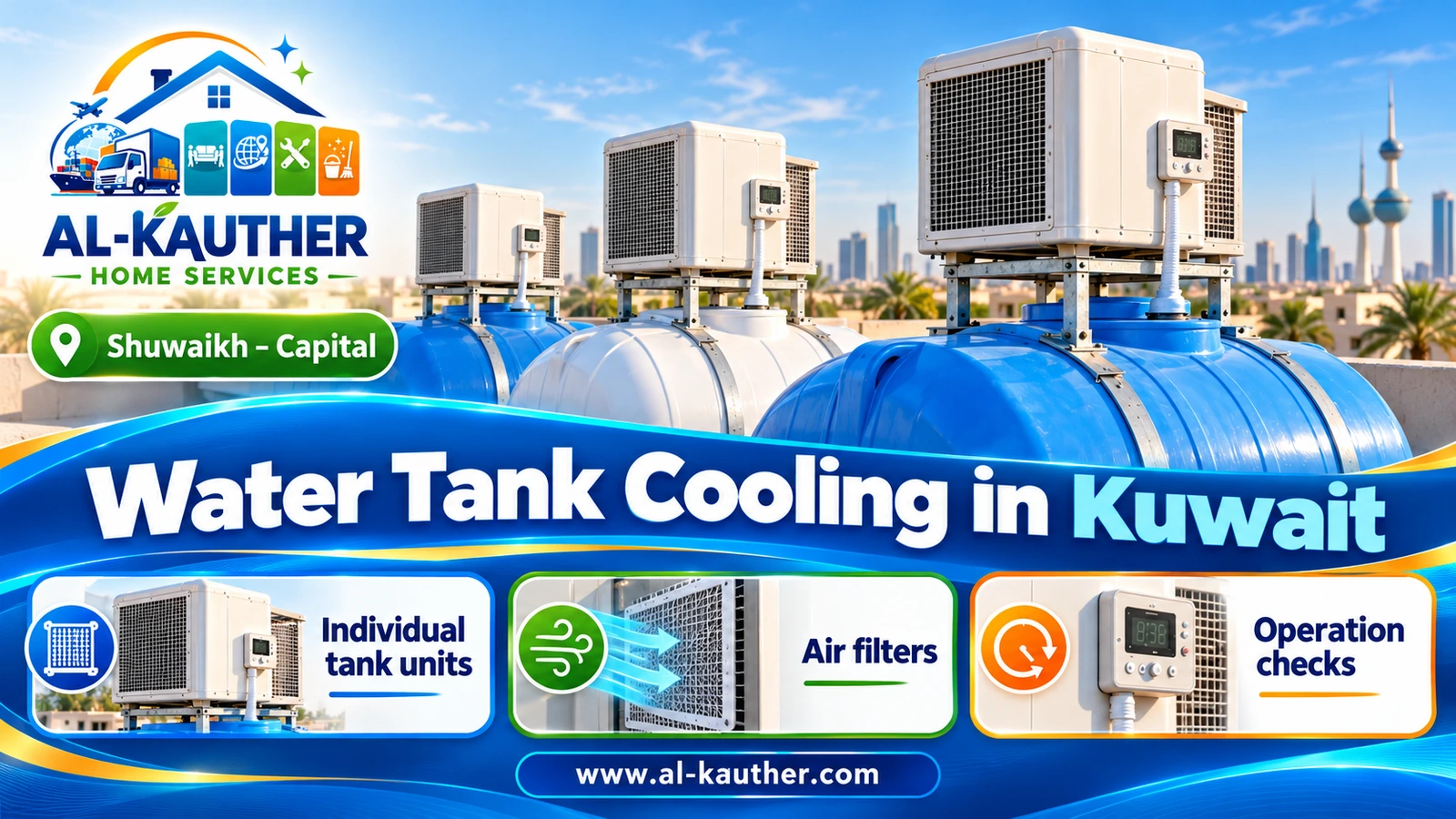
We install tank coolers in all six governorates of Kuwait, and the team is spread so that nearby areas are usually reached the same day.
- Capital Governorate: Shamiya, Kaifan, Khaldiya, Rawda, Adailiya, Qadsiya, Dasma, Shuwaikh, Sulaibikhat, Granada, Nuzha.
- Hawalli Governorate: Salmiya, Jabriya, Mishref, Bayan, Salwa, Rumaithiya, Shaab, Hateen, Salam, Zahra.
- Farwaniya Governorate: Farwaniya, Khaitan, Ardiya, Rabia, Andalus, Rehab, Omariya, Ishbiliya, Abdullah Al-Mubarak.
- Ahmadi Governorate: Fahaheel, Mangaf, Fintas, Abu Halifa, Sabahiya, Riqqa, Hadiya, Sabah Al-Ahmad, Jaber Al-Ali.
- Jahra Governorate: Jahra, Qasr, Naeem, Oyoun, Waha, Saad Al-Abdullah, Taima.
- Mubarak Al-Kabeer Governorate: Sabah Al-Salem, Qurain, Adan, Qusour, Messila, Abu Ftaira, Fnaitees.
How we follow up after installing a cooler
After installation we follow the unit’s performance with you over the first days, because the first real heatwave shows any setting that needs adjusting. If a fault caused by the installation appears within the agreed period, such as dust getting past the seal, a loose fixing or a connection problem, we come back and fix it. Defects in the unit itself are covered by the dealer’s or maker’s terms for that brand, which we explain before you buy.
What you get after installation:
- An explanation of how to run the unit, the timer and the isolator.
- A short schedule for cleaning the filter or condenser.
- A follow-up call in the first week of use.
- A return visit if an installation problem appears within the agreed period.
If you also want to treat the water for purity, cooling can be combined with central filter installation in Kuwait in a single visit, and a crack in a plastic or fiberglass tank can be fixed before installation through water tank welding in Kuwait.
Tank cooler installation in Kuwait
Daily from 8 am to 10 pm. Call or WhatsApp us on 65550977.
Call 65550977 WhatsApp