

Water tank repair in Kuwait with Al-Kauther Home Services means a technician comes to your roof or to the hatch of your underground tank, finds the cause first and then fixes it: a leak from the tank body or its fittings, a float valve that will not shut off or will not let the tank fill, a worn valve, a broken lid, or removing an old tank and installing a replacement. We cover all six governorates of Kuwait. Leak detection starts from KWD 9.500, mechanical float valve replacement from KWD 13.500, and welding a small crack in a plastic tank from KWD 13.500. To get in touch, call or WhatsApp us on 65550977.
This guide is written for the homeowner who sees a wet patch on the roof or hears the pump running non-stop and is not sure where to start. You will find a table linking each symptom to its most likely cause, an explanation of what can be repaired on site and what needs replacing, our starting prices and what pushes the cost up or down, and the areas we cover in every governorate.
In short
- Services: tank leak detection, repair of plastic and fiberglass tank bodies, float valve repair and replacement, replacement of valves, fittings and lids, underground tank maintenance, tank removal and installation.
- Prices: leak detection from KWD 9.500, mechanical float valve from KWD 13.500, electric float switch from KWD 75, tank removal and installation from KWD 19, fiberglass tank repair from KWD 18.
- Time: most faults are fixed in one visit of one to three hours; it takes longer when a repair has to cure before the tank is refilled.
- Coverage: Capital, Hawalli, Farwaniya, Ahmadi, Jahra and Mubarak Al-Kabeer.
- Working hours: daily, 8 am to 10 pm.
- Contact: call or WhatsApp 65550977; a photo of the fault and your location helps.
What does water tank repair in Kuwait cover?
Water tank repair in Kuwait covers everything that stops a tank from doing its job: filling to the right level, stopping there, holding water without seeping, and delivering it to the house at a steady pressure. So our work is not limited to sealing a crack in the tank wall. It extends to the parts around it, because most of the calls we get from Kuwaiti homes are caused by a small component next to the tank rather than the tank itself.
- Tank body: cracks and holes in polyethylene or fiberglass tanks, and cracking in concrete underground tanks.
- Float valve: a stuck mechanical float or bent arm, or an electric float switch that will not start or stop the pump.
- Valves and fittings: inlet valve, outlet valve, drain valve, threaded tank connectors and flexible hoses.
- Lid and vent: a broken lid that lets in dust and insects, or a blocked vent pipe that disturbs filling.
- Base and stand: an uneven base that stresses the bottom of the tank and causes cracks over time.
- Removal and installation: taking down a damaged tank and fitting a replacement, or moving a tank to another spot on the roof.
If the fault is a crack that needs welding, it is done in the same visit once the area is drained and dried. The welding methods, materials and the cases where welding will not work are explained in our guide to water tank welding in Kuwait, so this page can stay focused on diagnosis and general maintenance.
From symptom to fix: a tank fault diagnosis table
The quickest route to a repaired tank is knowing exactly what you are seeing before you call. The table below sums up the most common symptoms in Kuwaiti homes, the cause we usually find behind each one, and what we do about it.
This is what we come across on our visits, from most to least common:
| What you notice | Likely cause | What we do |
|---|---|---|
| Water running from the overflow pipe or onto the roof | Float valve not closing or a worn valve washer | Adjust the arm, replace the washer or the whole float valve |
| Tank never fills to the top | Float set too low or a clogged inlet strainer | Recalibrate and clean the strainer |
| Pump starts, stops quickly and starts again | Electric float switch fault or a leak in the delivery line | Check the sensor and wiring, test the line |
| Permanent damp patch under the tank | Crack in the base or a leaking drain valve | Drain, inspect the base, then weld or replace the valve |
| Drips around a side connector | Loose tank connector or a failed seal | Remove the connector, replace the seal, re-tighten |
| Water bill rising for no clear reason | Silent leak from the underground tank or overflow | Level test with all valves closed |
| Sand or insects in the water | Broken lid or an unmeshed vent | Replace the lid, fit a mesh, then wash the tank |
Notice that three of the seven symptoms come from the float valve or a valve, not from the tank body. That is why we always start with an inspection before talking about welding or replacement, and we never suggest changing a tank when the problem is a low-cost part.

Signs your tank needs a technician now
Your tank needs a technician straight away when water seeps into the ceiling or walls, when it overflows constantly, or when the house runs dry even though the supply is coming in. In Kuwait these cases cannot wait, because water leaking on a roof finds its way into the insulation layers and then shows up as cracks and damp on the ceilings of the rooms below.
Constant overflow from the rooftop tank
If water has been running from the overflow pipe for hours, the float valve is not doing its job. Wasted water is not the only loss: the pump works beyond its capacity, the roof stays wet and the damp reaches the insulation. The fix is usually simple and takes less than an hour.
A damp patch on the ceiling or around the tank base
A patch that grows day by day means a continuous leak. It may come from the bottom of the tank, the lower drain valve or the outlet connection. Do not try to cover it with silicone from outside: the water will find another path and you lose track of the real source.
Low pressure or no water at the taps
When the tank is full but water reaches the taps weakly, the cause is often a half-closed outlet valve, a strainer clogged with sediment, or air trapped in the line after a supply cut. When the tank is empty even though the pump is running, we check the float, the pump and the delivery line together.
The pump never seems to stop
A pump that cycles on and off every few minutes, or never stops, is telling you there is a fault in the electric float switch or a leak in the line between the pump and the tank. Leaving it this way burns out the pump winding and pushes up the electricity bill.
Water tastes or looks different since the leak appeared
If the leak came with a change in taste or cloudy water, there is an opening letting in dust or outside water. After the repair we recommend washing and disinfecting the tank; the steps are covered in our guide to tank cleaning and washing in Kuwait.
Why do water tanks wear out faster in Kuwait?
Water tanks wear out faster in Kuwait because of the extreme heat and strong ultraviolet light on exposed roofs, together with dust and wide temperature swings between day and night. None of this breaks a tank in a day, but it weakens the material little by little until the first crack appears.
- Ultraviolet light: makes the surface of a plastic tank brittle over the years, until it feels chalky and cracks under the first stress.
- Expansion and contraction: the tank body and pipes expand at midday and shrink at night, so threaded connectors loosen and start to drip.
- Dust and sandstorms: dust gets in through an open lid and the vent, settles on the bottom, clogs strainers and hampers the float.
- Pump pressure and water hammer: a strong pump that shuts off suddenly sends shocks along the line that strain fittings and valves.
- An uneven base: a full tank can weigh more than a tonne, and any tilt in the base puts more load on one part of the bottom than it can take.
- Water quality: dissolved salts leave scale on the float and valve washer so they no longer seal fully.
A note from the field
Most of the cracks we repair in tank bottoms start from a small stone or a bump in the concrete base under the tank. So we check the base on every visit and level it, or lay a flat board, before refilling.
Water tank leak detection in Kuwait before any repair
Leak detection is the first step of any water tank repair in Kuwait, and it starts from KWD 9.500. The aim is to pinpoint the source: the tank body, a fitting, a valve, or the pipework after the tank. Without this step, a crack might be welded while the leak carries on, because it was coming from somewhere else.
How do we find the source of the leak?
- Level test: we close the inlet and outlet valves, mark the water level and watch it. If the level drops with every valve closed, the leak is in the tank or its connectors.
- Targeted visual check: we follow the trail of water on the roof and the tank body from the bottom up, since water always runs down from the highest leak point.
- Dry-wipe test on fittings: we dry each connection with a cloth and watch which one gets wet first.
- Thermal camera where needed: it reveals hidden moisture under insulation or inside a wall when the line after the tank is leaking.
Internal versus external leaks
An external leak comes from a visible crack or fitting and is easy to reach. An internal leak runs through the wall or floor of an underground tank into the soil, or the other way round: groundwater or sewage getting into the tank. The second case is more serious because it contaminates drinking water; the signs are a change in smell, or the underground tank level rising without being filled.
Emergency leaks: a temporary stop, then a permanent repair
If the leak is strong and the tank is full, we stop it temporarily with a compound that sets under water until the tank can be drained. That is a first-aid measure for a few hours or days, not a final repair. The permanent repair is carried out on a dry, clean surface and tested before refilling.
Repairing the tank body: plastic, fiberglass and steel
The tank body is repaired according to its material: polyethylene is heat-welded with a rod of the same plastic, fiberglass is rebuilt with layers of glass fibre and resin, and a steel tank needs metal welding followed by an anti-rust coating. Glue and silicone are not a lasting fix for any of them.
Here we keep to what helps you decide. A short crack in the wall of a plastic tank can usually be welded, a small hole in fiberglass can be rebuilt well, but a tank whose whole surface has been cracked by the sun cannot be saved by welding. Welding a small crack in a plastic tank starts from KWD 13.500 and fiberglass repair from KWD 18. For the method step by step, the materials, and the difference between hot-air welding and resin repair, see our water tank welding guide for Kuwait.
When do we recommend repair, and when not?
We recommend repair when the defect is in one or two spots and the tank body is sound. And we tell you plainly when a tank has reached the end of its life, because repeated repairs on a worn tank cost more than a new one.
Water tank float valve repair in Kuwait
Water tank float valve repair in Kuwait starts from KWD 13.500 for replacing a mechanical float valve and from KWD 75 for an electric float switch. The float is the part that decides when water comes in and when it stops, and any fault shows up immediately as either an overflowing tank or a tank that never fills.
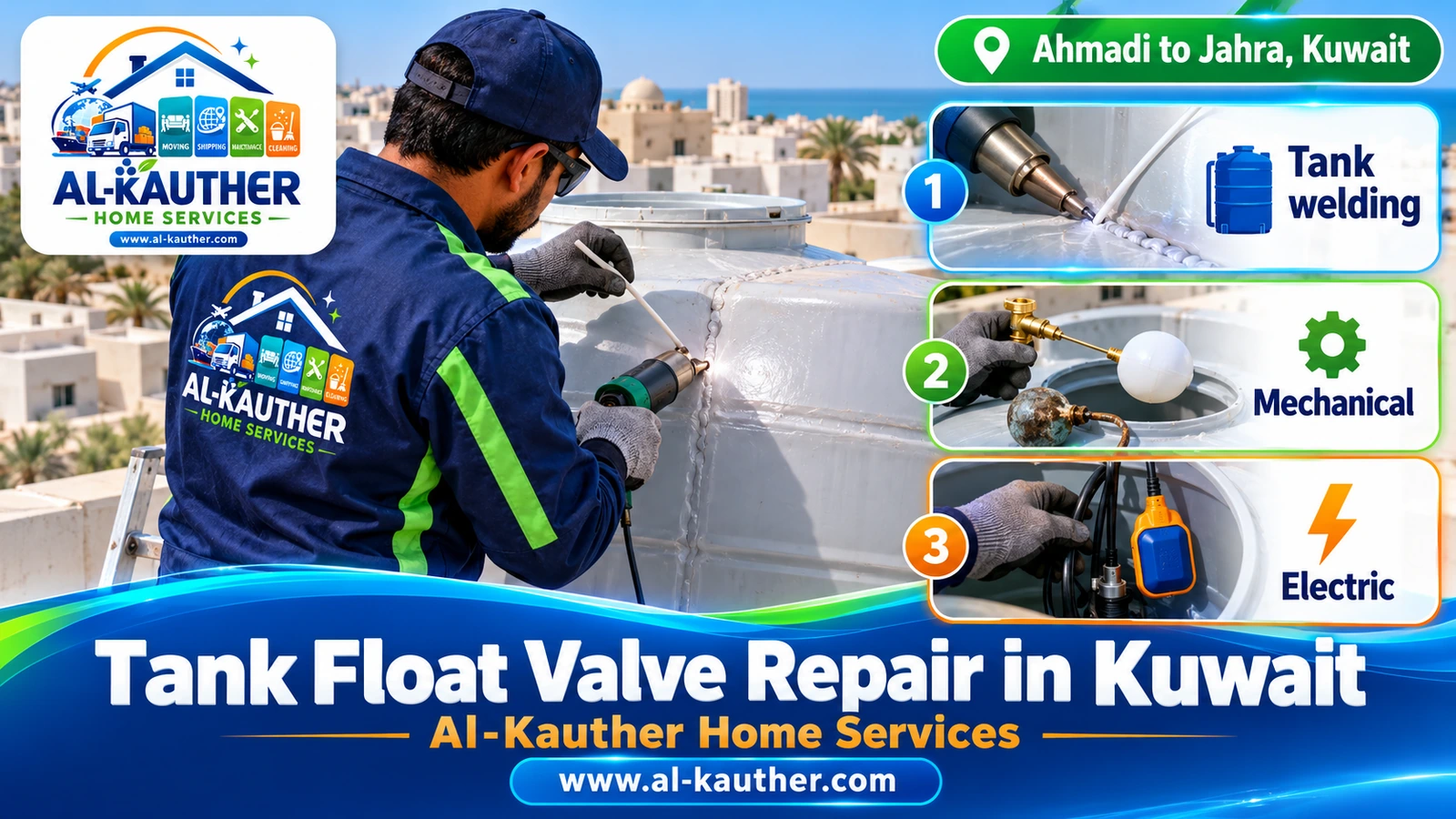
The most common float valve faults
- A punctured ball that has filled with water and no longer rises, so the valve stays open.
- A bent or loose arm, so the valve shuts before the tank is full or after it overflows.
- A worn valve washer, or one coated with scale, that no longer seals completely.
- For electric floats: a broken wire, a sensor stuck in sediment, or a bad connection to the pump panel.
Adjust or replace the float valve?
We adjust the float when the ball is intact, the arm is straight and only the level is wrong; that takes minutes. We replace the washer if the problem is sealing. If the part is corroded, broken or keeps failing, replacing it is cheaper than fixing it every month. We use brass or high-grade plastic float valves, and you are welcome to choose the type you prefer.
Types of tank float valves and where each fits
The right float depends on the tank size and whether there is a pump. Here is a short comparison:
| Float type | How it works | Best for | Note |
|---|---|---|---|
| Mechanical ball-and-arm | The ball rises with the water and closes the valve | Rooftop tanks fed from the mains, or underground tanks | Simple and easy to maintain |
| Electric (level switch) | Starts the pump when the level drops and stops it when full | Homes pumping from the underground tank to the roof | Protects the pump from running dry |
| Electronic or smart | Several sensors and a control panel, sometimes app-linked | Apartment blocks and large buildings | Costs more and needs a specialist |
Steps for fitting a new float valve
- Switch off the pump and close the inlet valve.
- Open the lid, inspect the inside of the tank and clear any sediment around the fitting area.
- Choose a position where the float will not catch on the tank walls or pipes.
- Fix the float and tighten the connection; for an electric float, run the cable through a dedicated opening and seal it against dust.
- Fill the tank and watch it shut off at the required level, then drain some water to confirm it refills.
Tank overflowing or not filling?
Send a photo of the float or the leak on WhatsApp and we will tell you the likely cause and the earliest visit slot in your area.
Valves, fittings, lid and vent
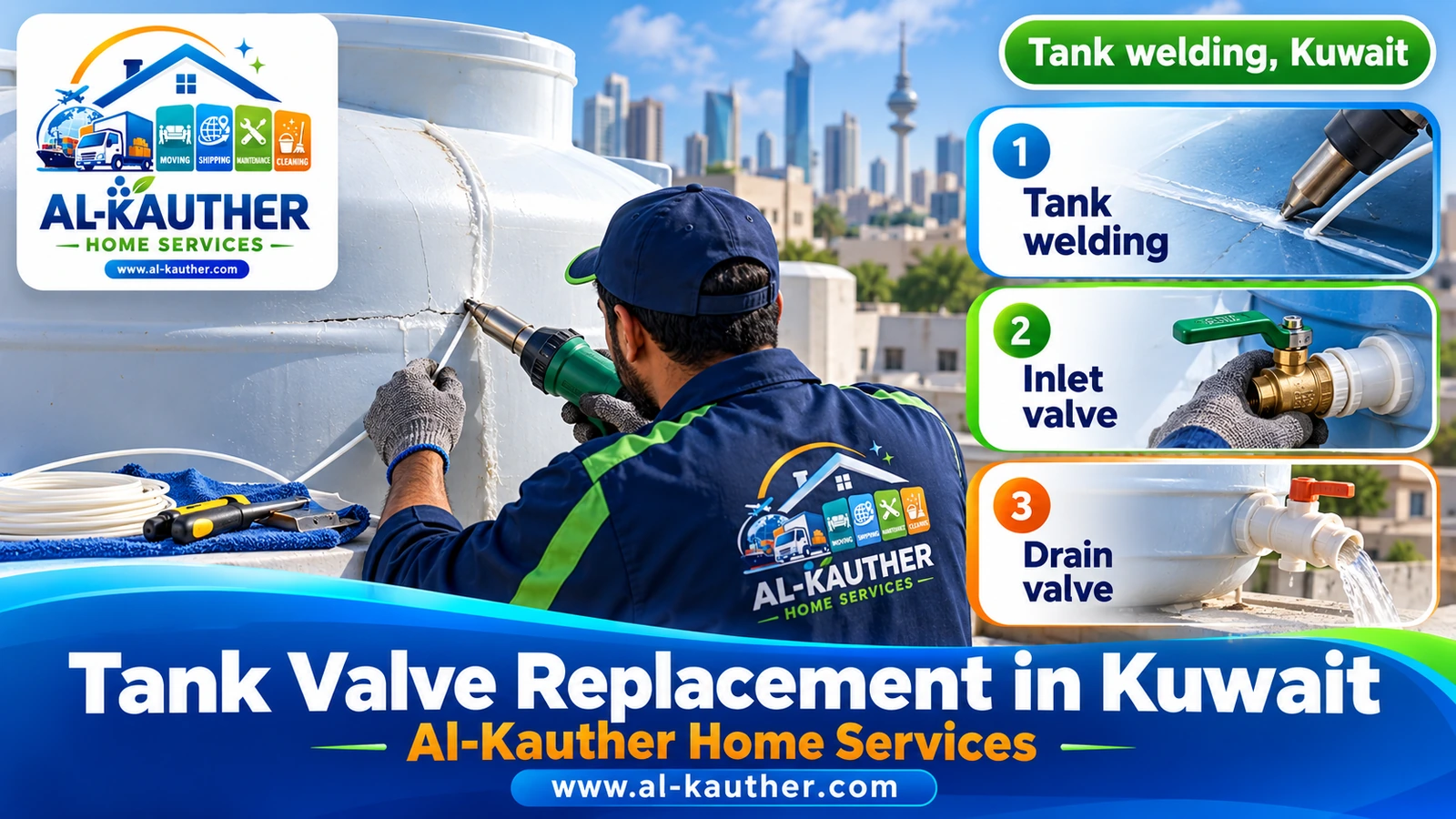
Valves and fittings are the parts that fail most often around a tank in Kuwait, because they face sun, pressure and expansion at the same time. The price for replacing a valve or fitting is set after inspection according to the part type and size, since a brass valve differs from a plastic one and a half-inch fitting differs from a two-inch one.
- Inlet valve: if it does not close fully, you cannot repair the float or wash the tank without water pouring in.
- Outlet valve: a full-bore ball valve is best so it does not reduce pressure in the house.
- Lower drain valve: essential for washing, and often found leaking because its washer has dried out in the heat.
- Threaded tank connectors: we replace the seal and re-tighten to a sensible torque, because overtightening cracks the wall of a plastic tank.
- Flexible connectors: they absorb pump vibration and thermal movement so stress is not passed on to the tank body.
- Lid: a broken or loose lid lets in dust, birds and insects, and replacing it costs far less than repeated washing.
- Vent: we fit a fine stainless steel mesh so air gets in while dust and insects stay out.
Underground water tank maintenance in Kuwait
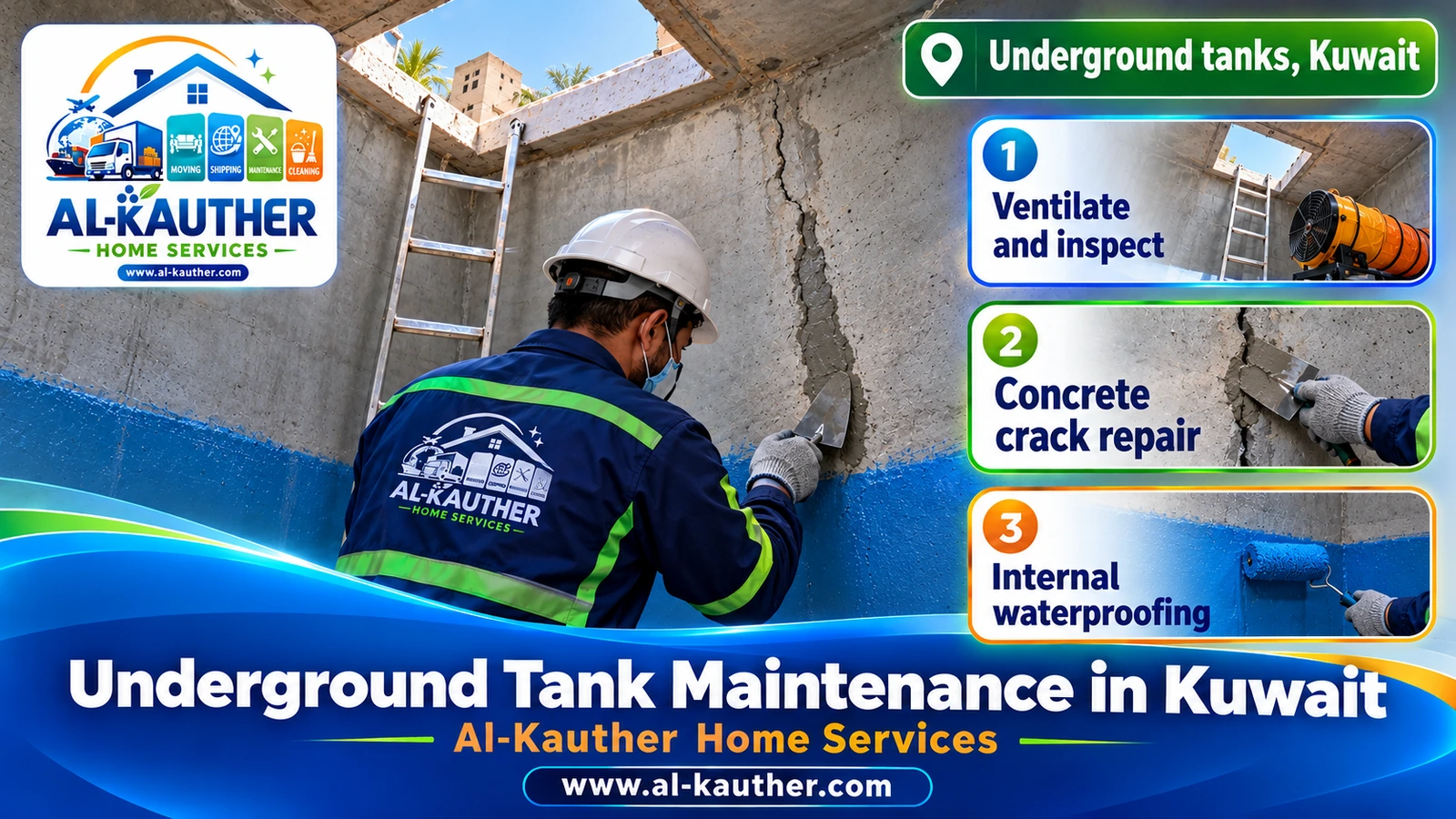
Underground water tank maintenance in Kuwait differs from rooftop tank work because most underground tanks are buried concrete, and their leaks are not easy to see. Maintenance starts with draining and ventilating the tank, then inspecting the walls, floor, roof slab, access hatch and supply pipes.
Treating cracks in a concrete tank
Weak cracks are opened up and cleaned, then filled with a special fast-setting cement mortar. The tank is then coated with a waterproof layer suitable for drinking water, such as a cementitious or crystalline coating that penetrates the pores of the concrete, or an epoxy approved for water contact. We avoid oil-based paints used for warehouses and garages, as they are not suitable for water.
When sewage or groundwater gets into the tank
In this case the entry point must be sealed first, then the contaminated water treated and pumped out, then the damaged floor or wall rebuilt, and the tank left for a while to confirm the seepage has stopped before waterproofing. After that the tank is washed and thoroughly disinfected before its water is used.
What a sound underground tank looks like
- An access hatch wide enough for a cleaner to enter safely, with a tight lid raised above ground level.
- As far as possible from sewer lines and inspection chambers.
- A smooth inner coating that does not hold sediment or encourage algae.
- A drain pipe or point for emptying water during washing.
Water tank removal and installation in Kuwait
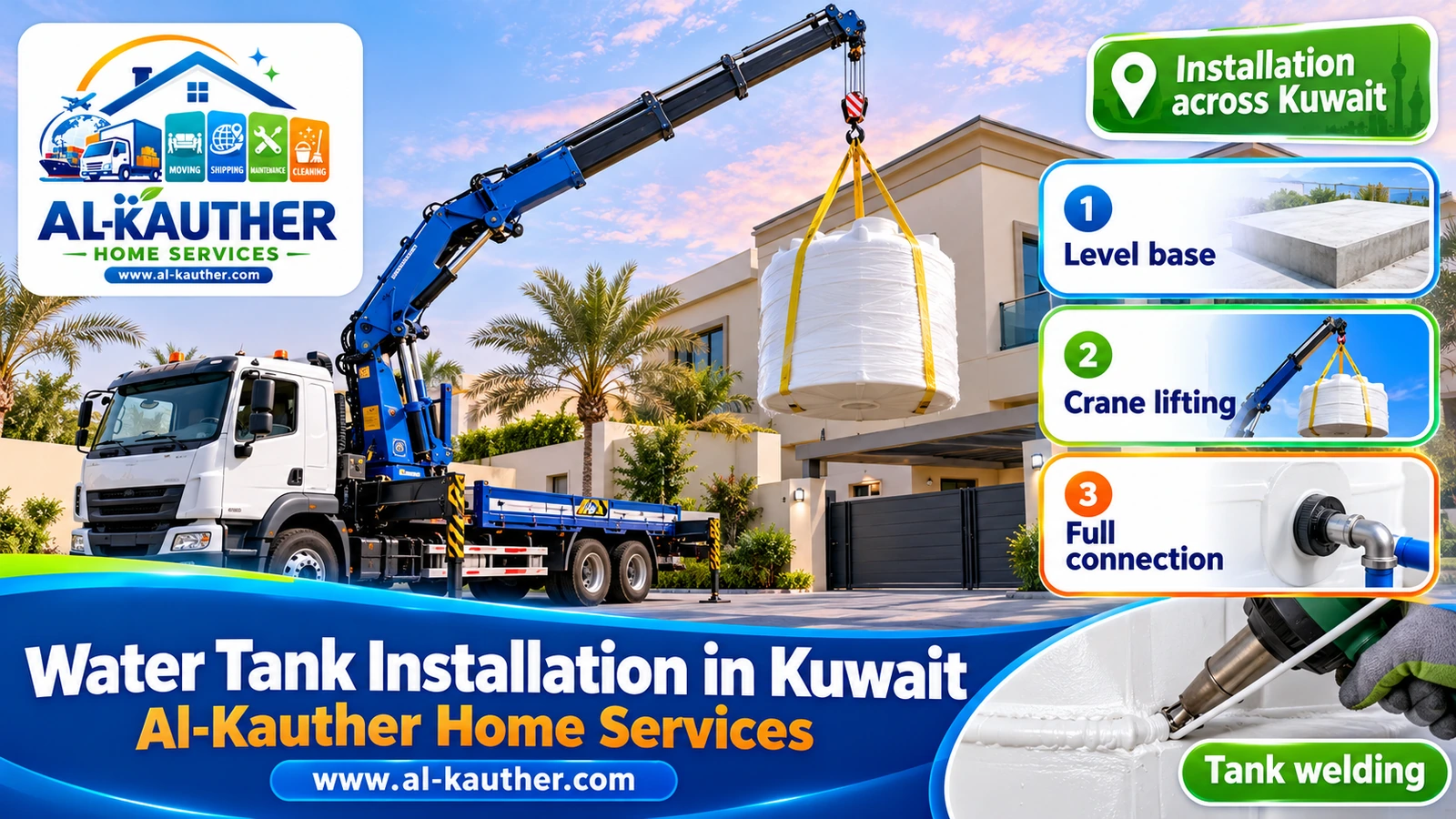
Water tank removal and installation in Kuwait starts from KWD 19 for labour. It covers draining the old tank, disconnecting its fittings and taking it down, then lifting the new tank, fixing it on a level base, connecting the inlet, outlet, overflow and float valve, and testing everything before we leave. The price changes with tank size, the lifting method and the installation spot.
A tank needs to come down when it is damaged beyond repair, when you want more capacity, when the roof is being repaired and insulated, or when moving the tank to a shadier spot. In homes where the stairs are too tight, we arrange lifting by rope or crane depending on the tank size.
- Choose the new location and make sure the roof can carry the tank when full.
- Prepare a completely level base with no gravel or bumps.
- Fit new connectors firmly without overtightening.
- Connect the float valve and run the overflow away from the roof insulation.
- Fill, test and watch the fittings before handing over.
If you are looking for a new tank, a used one in good condition, or a straight swap for your current tank, you will find the options and capacities in our guide to water tanks for sale in Kuwait.
Repair the tank or replace it?
Repair is the right choice when the fault is limited and the tank body is sound; replacement makes more sense when cracks keep coming back or the tank has lost its strength. We give you both options with their figures and leave the decision to you.
Repair is usually enough when:
- The fault is in the float valve, a valve or a fitting.
- The body has a single short crack away from the bottom and the connectors.
- The surface of the tank is firm and does not crumble when rubbed.
Replacement is usually better when:
- Several cracks have appeared in different places within a short time.
- The surface has turned chalky and brittle from the sun, or the tank has bulged out of shape.
- The crack is in the bottom under full load, or runs around several connectors.
- The taste or smell of the water has changed permanently because the material has aged inside.
How a tank repair visit works, from call to handover
- Contact: you call or WhatsApp 65550977 with a photo of the fault, your location and the tank type if you know it.
- Scheduling: we agree a visit time within our hours, 8 am to 10 pm.
- Inspection: the technician identifies the cause, explains it and gives the price before starting.
- Work: partial or full draining where needed, then the repair or replacement.
- Testing: filling the tank and watching the repaired spot, the fittings and the float valve.
- Clean-up and handover: we clear work debris from the roof and tell you what to keep an eye on over the next few days.
After the job we stay in touch: if the leak returns from the same spot within the period agreed at handover, we redo the repair at no extra labour cost.
Water tank repair prices in Kuwait
Water tank repair prices in Kuwait at Al-Kauther start from KWD 9.500 for leak detection, and from KWD 13.500 for replacing a mechanical float valve or welding a small crack in a plastic tank. The final price is confirmed after inspection, and you hear it before any work starts.
Starting prices for the most common tank repair jobs (Kuwaiti dinar):
| Service | What it covers | From (KWD) |
|---|---|---|
| Leak detection and inspection | Locating the source and explaining the fix | 9.500 |
| Mechanical float valve replacement | Part, fitting and testing | 13.500 |
| Electric float switch installation | Sensor, wiring to the pump and testing | 75 |
| Welding a small crack in a plastic tank | Draining, preparation, welding and testing | 13.500 |
| Fiberglass tank repair | Local rebuild with glass fibre layers and resin | 18 |
| Full repair with waterproofing | Treating several spots plus a waterproof layer | 22.500 |
| Tank removal and installation | Labour for lowering, lifting and connecting | 19 |
| Valve or fitting replacement | Depends on part type and size | Set after inspection |
What makes the price go up or down?
- The fault: adjusting a float valve is far simpler than rebuilding a tank bottom.
- Tank material: fiberglass needs more materials and curing time than welding polyethylene.
- Tank size and the number of tanks in the house.
- Access: a tank on a low roof is different from one on top of a tall annex or in a basement.
- Replacement parts: a brass or electric float, a brass valve, a new lid.
- Whether washing and disinfection are needed after the repair.
Before the visit: what speeds up the repair?
- Make sure the roof door can be opened and the roof reached at the visit time.
- Know where the main inlet valve and the pump switch are.
- If the fault is in the bottom, use up some of the tank water before the visit where possible.
- Send a photo of the fault in advance so the technician brings the right part from the start.
- Move stored items away from the tank to give clear access.
How to choose a tank repair technician in Kuwait
Choose a technician who inspects before quoting, explains the cause in plain words and uses the right material for your tank type. These points protect you from a repair that lasts a week before the leak comes back.
- Asks about the tank type, age and location before naming a figure.
- Refuses to seal a crack with silicone or putty from outside as a permanent fix.
- Tests the repair by filling the tank before leaving.
- Uses materials suitable for contact with drinking water.
- Follows safety rules on the roof and when entering an underground tank, such as ventilation, masks and gloves.
- Follows up after the job and comes back if the same problem reappears.
Tips to extend your tank life after a repair
Simple habits that protect your tank
- Shade the rooftop tank with a canopy or light cover; direct sun is the biggest enemy of plastic.
- Check around the tank once a month, especially after sandstorms.
- Keep the lid tight and the vent covered with mesh.
- Wash the tank regularly so sediment does not build up on the float valve and strainers.
- Do not run the pump when the underground tank is empty; consider an electric float switch to protect it.
In summer the water in a rooftop tank gets very hot. If that bothers you, there are cooling units made for tanks, covered in our guide to water tank cooler installation in Kuwait. And if the roof itself needs protecting from heat and leaks, see JetaRoof roof insulation in Kuwait.
Water tank repair across Kuwait’s six governorates
We carry out water tank repair in every governorate of Kuwait and schedule visits by area so the technician arrives at the agreed time. These are the main areas we work in:
Capital Governorate
Shamiya, Khaldiya, Rawda, Adailiya, Qadsiya, Kaifan, Dasma, Daiya, Yarmouk, Qurtuba, Surra, Nuzha, Faiha, Mansouriya, Abdullah Al-Salem, Granada.
Hawalli Governorate
Hawalli, Salmiya, Jabriya, Rumaithiya, Bayan, Mishref, Salwa, Shaab, Shuhada, Hittin, Zahra, Salam, Siddiq, Bidaa.
Farwaniya Governorate
Farwaniya, Khaitan, Andalous, Ardiya, Riggae, Omariya, Rabiya, Rehab, Ishbiliya, Jleeb Al-Shuyoukh, Sabah Al-Nasser, Firdous, Abdullah Al-Mubarak.
Ahmadi Governorate
Fahaheel, Mangaf, Abu Halifa, Fintas, Mahboula, Sabahiya, Riqqa, Hadiya, Egaila, Dhaher, Jaber Al-Ali, Sabah Al-Ahmad, Wafra, Khairan.
Jahra Governorate
Jahra, Qasr, Naseem, Oyoun, Naeem, Waha, Taima, Saad Al-Abdullah, Mutlaa.
Mubarak Al-Kabeer Governorate
Mubarak Al-Kabeer, Qurain, Adan, Qusour, Sabah Al-Salem, Messila, Abu Ftaira, Fnaitees, Abu Al-Hasaniya.
Other tank services from Al-Kauther in Kuwait
Tank repair is often part of wider care for your tank and household water, and each service has its own detailed guide:
Water tank repair in your area of Kuwait
Daily from 8 am to 10 pm. Call, or send a photo of the fault on WhatsApp.