
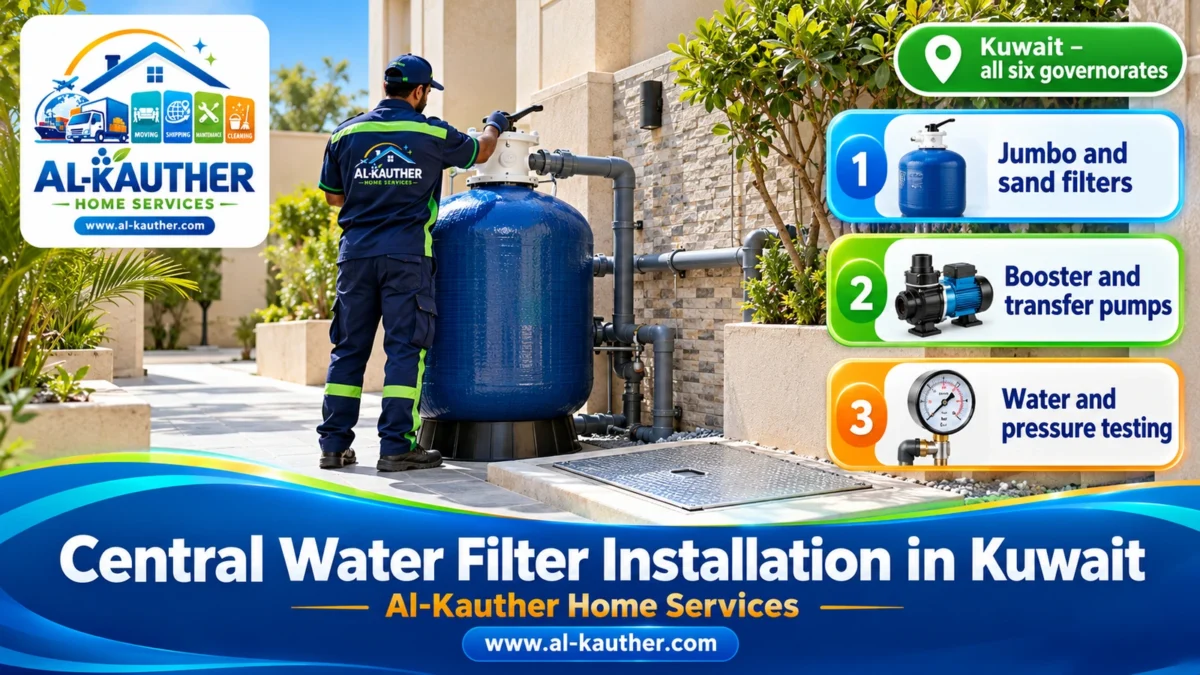
Central water filter installation in Kuwait: we fit a whole-house filter on your main water line — jumbo or sand — that traps sand, rust and sediment before it reaches your taps and heaters, and we install 5- and 7-stage kitchen filters, water booster pumps and pressure switches for homes where the upper floors get weak water. Jumbo central filter installation starts from KWD 47, a sand filter from KWD 155, and a half-horsepower pump with automatic switch and installation from KWD 38. To reach us, call or WhatsApp 65550977.
Water reaching your home in Kuwait passes through several stages before you drink or shower with it: it comes in through the meter to the underground tank, a pump lifts it to the roof tank, then it flows down by gravity or through a booster pump to the kitchen and bathrooms. At each stage the water can pick something up or lose some of its pressure. That is why this guide follows the water’s own journey: where the filter goes and why, which type suits you, then when you need a pump and what power to choose.
In short
- Service: water and pressure testing, jumbo or sand central filter installation, 5- and 7-stage kitchen filters, cartridge changes, booster, transfer and smart pump installation, pressure switches and flow switches, and pump maintenance.
- Prices: jumbo central filter from KWD 47, sand filter from KWD 155, kitchen filter from KWD 45.5, half-HP pump installed from KWD 38, 1 HP pump from KWD 64, smart pump from KWD 150.
- Timing: jumbo filter one to two hours; sand filter or pump with pipe changes two to four hours.
- Coverage: Capital, Hawalli, Farwaniya, Ahmadi, Jahra and Mubarak Al-Kabeer.
- Hours: daily from 8 am to 10 pm.
- Contact: call or WhatsApp 65550977.
From meter to tap: where do filters and pumps fit in your home?
In most Kuwaiti homes water moves through five stages: the meter, the underground tank, the transfer pump, the roof tank, and the distribution pipes to bathrooms and kitchen. A central filter goes at one of two points, a pump at one or two, and the drinking-water filter in the kitchen at the end of the journey.
| Stage | What happens to the water | What is fitted there |
|---|---|---|
| Meter and mains line | Arrives at mains pressure and may carry sand or rust from public pipes | A central filter before the underground tank to protect it from sediment |
| Underground tank | Water is stored and sediment can settle at the bottom | A suction pipe raised off the floor, and regular cleaning |
| Transfer pump | Lifts water to the roof | A pump sized to the building height, with a float switch or sensor |
| Roof tank | Heats up in summer and can let dust in | A tight lid, and cooling if needed |
| Distribution pipes | Flows down by gravity and weakens on the top floor | Booster pump and pressure switch, a central filter after the pump, a drinking filter in the kitchen |
Understanding this journey solves half the problem before we start: a home where cloudy water comes out of every tap needs a central filter; a home where the water is clean but weak on the second floor needs a booster pump; a home that wants better-tasting drinking water needs a kitchen filter — and one home may need all three.
Does Kuwait’s water need a central filter?
Yes, many homes in Kuwait benefit from a central filter — not because mains water is bad, but because most of Kuwait’s drinking water is desalinated and produced to a good standard, then travels a long way through pipes and is stored in two tanks before it reaches you. Along the way it picks up fine sand, rust from older pipes and sediment from tank floors. That is what you find in tap aerators, what clogs shower heads and what settles inside water heaters.
A central filter will not turn tap water into bottled water; its job is to protect the whole house — fixtures, heaters, washing machines, and your skin and hair — from sediment-laden water. Drinking water needs a multi-stage kitchen filter, which we cover further down.
Before choosing a filter: we test the water, check pressure and inspect the tank
Before recommending any filter in Kuwait we take three simple measurements on the survey visit, because the right filter for one home can be the wrong one for another:
- TDS test: a small meter measures dissolved salts in the water. The figure tells us whether a standard kitchen filter is enough or you need reverse osmosis (RO).
- Pressure test: we fit a gauge on the line to see how much pressure the water loses, since a filter adds resistance and a pump may be needed with it.
- Tank check: if the underground or roof tank is full of sediment, the filter will clog within weeks. In that case we recommend cleaning first.

Good to know: If your tank is dirty, start with water tank cleaning in Kuwait before fitting a filter; a filter traps sediment but cannot clean the tank the water comes from.
Types of water filters we install in Kuwait
Water filters in Kuwait fall into central filters that protect the whole house and point-of-use filters for drinking, cooking or the shower. Central filters treat large volumes at a coarser level; drinking filters treat a small volume very finely.
Jumbo central filter (two or three stages)
The jumbo filter is the most common in Kuwaiti homes: large 20-inch housings mounted in a row on the wall, the first with a sediment cartridge that catches sand and rust, the second with a finer sediment cartridge, and the third with a carbon cartridge that improves taste and smell and reduces chlorine. It sits on the main line, and cartridges are quick and easy to change, so it suits most houses and flats.
Central sand filter
A sand filter is a tall fiberglass vessel filled with graded layers of sand and gravel, with a valve that periodically backwashes the media. It handles much larger volumes than a jumbo filter and has no cartridges to replace, so it suits large villas, apartment buildings and homes where the water carries a lot of sand. It needs more space and a drain point nearby for backwash water.
5-stage and 7-stage kitchen filters
Kitchen filters sit under the sink with their own small faucet. A 5-stage reverse osmosis (RO) filter passes water through sediment and carbon stages, then a very fine membrane that removes most dissolved salts, then a final carbon stage. A 7-stage filter usually adds a mineral stage that returns some useful minerals and improves taste, plus another stage for sterilising or adjusting pH. It comes with a small storage tank holding filtered water ready to use, usually between 3.5 and 6 gallons.

UV and alkaline filters
A UV lamp sits inside a chamber the water flows through and deactivates bacteria and micro-organisms without chemicals; it is often chosen by people who store water for long periods or want an extra layer of protection. An alkaline stage raises the pH slightly and adds minerals, for people who prefer a particular taste.
Shower filters and water-cooler filters
A shower filter is a small unit fitted before the shower head that reduces chlorine and sediment on skin and hair — a partial fix for homes that cannot fit a central filter. A water-cooler filter goes on the line to a water dispenser or fridge, giving you chilled filtered water straight away.
This table compares the common types:
| Type | Where fitted | What it treats | Maintenance | Suits |
|---|---|---|---|---|
| Jumbo central, 2–3 stages | Main line | Sand, rust and sediment, plus taste and smell with carbon | Regular cartridge changes | Most houses and flats |
| Central sand filter | Main line or before the tank | Large volumes of sediment | Backwash, no cartridges | Large villas and buildings |
| Kitchen 5-stage RO | Under the sink | Dissolved salts, heavy metals, taste | Cartridges and membrane | Drinking and cooking water |
| Kitchen 7-stage | Under the sink | As 5-stage plus remineralising and taste | Cartridges, membrane, mineral stage | Those wanting better taste |
| UV | After the filter | Bacteria and micro-organisms | Lamp replacement | Extra protection |
| Shower filter | Before the shower head | Chlorine and sediment on skin | Cartridge refill | Quick partial fix |
Central filter installation in Kuwait: how the job is done
Central filter installation in Kuwait is done in a single day: a jumbo filter takes one to two hours and a sand filter two to four. These are the steps we follow:
- Choosing the position: either on the mains line before the underground tank to protect it from sediment, or after the booster pump on the distribution line to filter water going into the house. We decide based on where the problem comes from and the water pressure.
- Choosing the size: we match the filter connections to the main line diameter so the filter does not become a bottleneck.
- Fitting a bypass: three valves let us isolate the filter and change cartridges without cutting water to the house.
- Mounting the housings: on the wall with a steel bracket, in a shaded, accessible spot away from direct sun, which damages clear housings and encourages algae.
- Two pressure gauges: before and after the filter; the gap between them tells you when the cartridges need changing.
- Start-up and first flush: we open the water gradually, bleed the air and run the water until the carbon stage runs clear.
- Testing: we check joints for leaks, measure pressure at the furthest tap and show you how the bypass works.
Will a central filter lower your water pressure?
A central filter sized to the line diameter does not reduce water pressure noticeably, but a filter smaller than the line, or one with clogged cartridges, reduces it clearly. So every filter we install gets a gauge on each side: a small gap is normal, and a gap that grows over time means the first cartridge is blocked.
In homes that rely only on gravity from the roof tank, pressure is low to begin with and any extra filter takes some of it away. In that case we fit the filter after a booster pump, so the pump makes up what the filter takes.
When to change filter cartridges
How often you change filter cartridges in Kuwait depends on how much water you use and how clean your tank is. These are approximate intervals for an ordinary home; they get shorter in a large house or with a dirty tank:
| Stage | Job | Approximate change |
|---|---|---|
| First sediment cartridge | Catches sand and rust | Every 1 to 3 months |
| Fine sediment cartridge | Catches smaller particles | Every 3 to 6 months |
| Carbon cartridge | Taste, smell and chlorine | Every 3 to 6 months |
| RO membrane | Dissolved salts | Every two to three years depending on water and use |
| Final carbon and mineral stage | Improves taste | About once a year |
| UV lamp | Sterilising | About once a year |
| Sand filter | Sediment | Regular backwash, sand replaced after several years |

We price cartridge changes by the number of stages and the cartridge type; send us a photo of your filter on WhatsApp and we will tell you the price before the visit.
How to spot a good cartridge and avoid filter scams
Filter scams in Kuwait usually involve the cartridges, not the housings: a low-density sediment cartridge that clogs within days, a carbon cartridge with very little carbon inside, or a unit sold as 7-stage with some stages empty.
Signs to watch for:
- A good cartridge has real weight; compressed carbon block is heavier than granular.
- Ask to see the new cartridge in its wrapping before it is fitted.
- Ask for the micron rating of each sediment cartridge, for example 5 micron first, then 1 micron.
- For RO filters, ask for the membrane’s daily capacity in gallons, which sets how much water it produces.
- Test the water with a TDS meter before and after the filter; the real difference shows in the number.
Not sure which filter your home needs?
Send a photo of your main line and tank on WhatsApp, and we will suggest the type, position and price.
Call 65550977 WhatsAppWater booster pumps in Kuwait: when does your home need one?
Your home in Kuwait needs a water booster pump when the roof tank is not high enough above the highest tap, so water comes out weak on the upper floor or in the shower, or when an instant water heater cuts out because the pressure is below what it needs. You need a separate transfer pump when an underground tank feeds the roof tank.
Signs your home needs a pump:
- Water is weak on the second floor or roof annex but strong on the ground floor.
- The shower does not give a full spray, and the instant heater switches off.
- The washing machine takes a long time to fill.
- The roof tank does not fill during the day because mains pressure is low.
- Opening two taps at once makes both weak.
Types of household water pumps in Kuwait
Household water pumps in Kuwait come in three main types: a transfer pump that moves water from the underground tank to the roof, a booster pump that raises the pressure of water going to the taps, and a variable-speed smart pump that boosts pressure quietly and saves power. There are also pumps for special uses.
Transfer pump to the roof tank
A transfer pump draws water from the underground tank and lifts it to the roof tank, controlled by an electric float switch or sensor that stops it when the roof tank is full and prevents it running if the underground tank is empty. What matters most is enough power for the total lift, and a suction pipe set slightly above the tank floor so it does not draw up sediment.
Booster pump with automatic pressure switch
A booster pump is fitted after the roof or underground tank and starts automatically when you open a tap, thanks to an automatic pressure switch or a flow switch, then stops when you close it. A small pressure tank can be added to reduce how often it starts and stops.

Variable-speed smart pump
Smart pumps such as the Grundfos SCALA2 and DAB E.sybox change speed according to how many taps are open, giving steady pressure whether one tap or four are running. They are much quieter and only run at full power when needed. They cost more than a standard pump but are very comfortable in multi-storey villas.
Pumps for special uses
- Hot-water return pump: circulates hot water in the pipes so it reaches the tap immediately instead of running cold first.
- Pool pump: works with a sand filter to circulate and clean pool water.
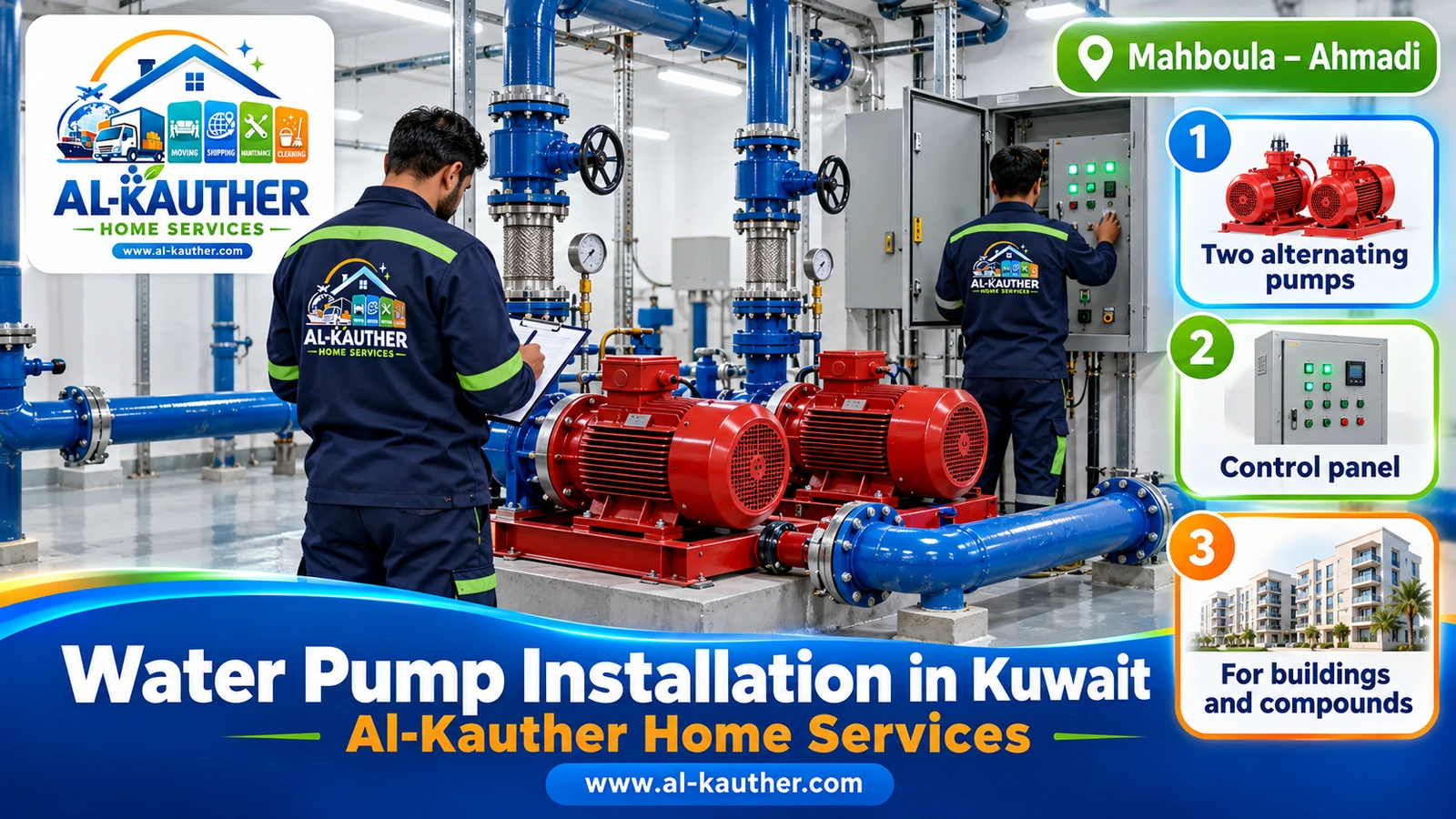
- Three-phase pumps: for apartment buildings and large premises, usually two pumps alternating with a control panel.
- Submersible pump: to drain water from basements or empty tanks during cleaning.
| Pump type | Job | How it is controlled | Suits |
|---|---|---|---|
| Transfer pump | Underground to roof tank | Electric float switch or sensor | Every home with an underground tank |
| Standard booster | Raises tap pressure | Pressure switch or flow switch | One- or two-storey homes |
| Smart pump | Steady, quiet pressure | Electronic variable speed | Multi-storey villas |
| Hot-water return | Circulates hot water | Timer or thermostat | Homes with a central heater |
| Three-phase | Pressure for a whole building | Control panel, two pumps alternating | Apartment blocks and compounds |
Quarter, half or 1 horsepower: how to choose pump power
Pump power in Kuwait should be chosen by the number of floors and how many outlets run at the same time, not on the idea that stronger is better. An oversized pump causes excess pressure that damages taps and heaters, cycles on and off constantly and uses more electricity.
| Home | Approximate power | Note |
|---|---|---|
| Flat or annex, one or two bathrooms | Quarter to half HP | A small quiet booster |
| One- or two-storey house | Half to 1 HP | With pressure switch or pressure tank |
| Three-storey villa or more than 5 bathrooms | 1 to 1.5 HP or a smart pump | Speed control recommended |
| Lift from underground tank to a high roof | Depends on total lift | We calculate height and pipe length |
| Apartment building | 2 HP and above, three-phase | Two alternating pumps |
These are guide figures; on the survey we measure the height between the tank and the highest outlet, count bathrooms and heaters, then set the power.
Pressure switch, flow switch and pressure tank: what is the difference?
An automatic pressure switch starts the pump when pressure in the pipes drops and stops it when pressure rises, while a flow switch starts it when it senses water moving and stops it when flow stops. A pressure tank is a small vessel with compressed air that stores some water under pressure, so the pump does not start every time a tap is opened briefly.
Many household pump faults come from a failed pressure switch or a pressure vessel whose air charge has leaked away, so the pump starts and stops every few seconds. Replacing a pressure switch or flow switch starts from KWD 13.5 with us, far cheaper than replacing the pump.
Installing a water tank with a pump — and can you do without one?
Installing a water tank with a pump means planning all three together: tank position, pump position and the pipe route between them. We place the pump close to the tank it draws from, under a cover that protects it from sun and rain, on a raised base, with a non-return valve to stop water flowing back and isolation valves before and after it for easy servicing. If you are buying a new tank, see water tanks for sale in Kuwait to pick a size that suits the pump.
You can skip the booster pump if the roof tank is high enough above the highest tap — raised on a steel stand, for example — or if the pipes are short and wide. But in most two-storey homes in Kuwait the top floor stays weak without a pump, especially with instant heaters.
Water pump brands available in Kuwait
The best-known water pump brands in Kuwait are Grundfos from Denmark, Wilo from Germany, Pedrollo, Calpeda and DAB from Italy, and ESPA from Spain, along with budget brands such as LEO and quiet shower-pump brands such as Salamander. People searching for “Italian water pumps” usually mean Pedrollo, Calpeda or DAB.
We install the pump you choose, or suggest one that suits your home and budget, keeping in mind spare parts and service availability in Kuwait — a pump you cannot get parts for has to be replaced entirely.
Common household water pump problems and fixes
Most household water pump problems in Kuwait show a clear symptom that points to the cause. This table lists the faults we see most often:
| Symptom | Likely cause | Fix |
|---|---|---|
| Starts and stops every few seconds | Pressure tank lost its air, or faulty pressure switch | Recharge the pressure tank or replace the switch |
| Never stops running | Leaking pipe, open tap or stuck sensor | Trace the leak and replace the sensor |
| Runs but no water comes out | Air in the pump, failed non-return valve or empty tank | Prime the pump and replace the valve |
| Loud noise and vibration | Worn bearing, loose base or drawing air | Replace the bearing and secure the base |
| Leaking from the pump body | Worn mechanical seal | Replace the seal |
| Overheats and trips | Running dry, failed capacitor or low voltage | Dry-run protection and an electrical check |
A pump service and diagnosis visit starts from KWD 9.5, with spare parts priced by type and pump brand.
Filter and pump installation prices in Kuwait
Filter installation prices in Kuwait with us start from KWD 47 for a jumbo central filter, and pumps with installation start from KWD 38 for a half-horsepower pump with automatic switch. Here are the main prices:
| Service | Price from |
|---|---|
| Jumbo central filter, installed | KWD 47 |
| Central sand filter | KWD 155 |
| 3- or 5-stage kitchen filter | KWD 45.5 |
| Half-HP pump with automatic switch, installed | KWD 38 |
| 1 HP pump with automatic switch, installed | KWD 64 |
| Roof-tank transfer pump with float switch, installed | KWD 56 |
| Grundfos smart pump | KWD 150 |
| Hot-water return pump | KWD 33 |
| Pool pump, installed | KWD 140 |
| Three-phase pump with control panel | KWD 142 |
| Central system (heater, pump and filter) | KWD 610 |
| Pressure switch or flow switch replacement | KWD 13.5 |
| Pump service and diagnosis visit | KWD 9.5 |
| Filter cartridge change | By number of stages, from a WhatsApp photo |
How the final price is set: The base price covers a standard installation; if the job needs extra pipework, line changes or a pump base, we tell you the cost before we start.
A filter and pump are no substitute for a sound tank
The best filter and the strongest pump will not give you good water if the tank itself is cracked and lets dust in, or leaks and lets air into the pump. So we check the tank on the survey, and if we find a problem we recommend water tank repair in Kuwait before fitting the filter. And if water comes out of the roof tank hot in summer, the answer is water tank cooler installation in Kuwait.
Filter and pump installation across Kuwait’s governorates
We install central filters and pumps in every governorate of Kuwait, including these areas we visit often:
- Capital: Shuwaikh, Kaifan, Rawda, Faiha, Nuzha, Qadsiya, Mansouriya, Surra.
- Hawalli: Hawalli, Salmiya, Jabriya, Mishref, Bayan, Salwa, Siddiq, Shuhada, Hittin.
- Farwaniya: Farwaniya, Khaitan, Rabiya, Rehab, Omariya, Ardiya, Andalus, Sabah Al-Nasser.
- Ahmadi: Fahaheel, Mangaf, Abu Halifa, Sabahiya, Dhaher, Egaila, Mahboula, Sabah Al-Ahmad.
- Jahra: Jahra, Qasr, Naseem, Taima, Oyoun, Jaber Al-Ahmad, Saad Al-Abdullah.
- Mubarak Al-Kabeer: Sabah Al-Salem, Adan, Qurain, Qusour, Messila, Sabhan, Wista.
Follow-up and maintenance contracts
After installation we can remind you when cartridges are due, and we offer regular maintenance visits for filters and pumps in homes and buildings by agreement. If a joint we fitted leaks, or a pump fault caused by the installation returns within the agreed period, we fix it at no extra cost.
A central filter or pump for your home in Kuwait
Call or WhatsApp us a photo of your line or current pump and your area, and we will send you the solution and price.
Call 65550977 WhatsApp