
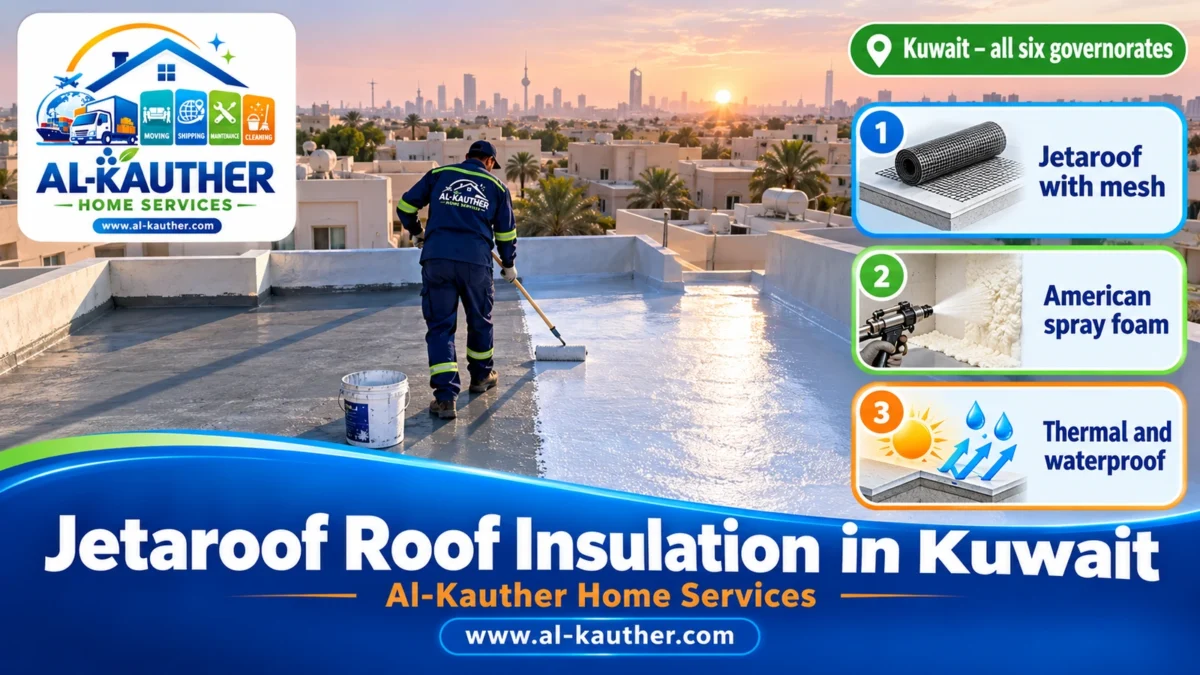
Jetaroof roof insulation in Kuwait is a flexible liquid acrylic membrane brushed onto the roof, reinforced with fiberglass mesh and finished with a reflective top coat. It stops rainwater and AC condensate from seeping into the ceiling and takes some of the sun’s heat off the top floor. Alongside Jetaroof, Al-Kauther Home Services applies American spray foam (polyurethane), combined thermal and waterproof systems, and insulation for water tanks and metal (kirbi) roofs across all six governorates of Kuwait. Jetaroof starts from 4.4 KWD per square meter, spray foam from 3.6 KWD and bitumen membrane from 2.55 KWD. To reach us, call or WhatsApp 65550977.
This guide is for the homeowner who stands on the roof after spotting a yellow stain on the ceiling below, or a crack around an AC base, and asks: is Jetaroof enough, or do I need spray foam? And what will it cost per meter? You will find how to diagnose your roof, the real differences between materials, and what you should receive on handover day.
In short
- Services: Jetaroof with fiberglass mesh and reflective coat, American spray foam, bitumen membrane, thermal boards, combined systems, plus tanks, kirbi roofs, garages and pools.
- Prices: Jetaroof from 4.4 KWD/m², spray foam from 3.6, bitumen from 2.55, thermal boards from 2.9, combined system from 5.2 KWD/m².
- Duration: An average house roof takes one to two working days with Jetaroof or spray foam; a combined system takes 3 to 5 days depending on area.
- Coverage: Capital, Hawalli, Farwaniya, Mubarak Al-Kabeer, Ahmadi and Jahra.
- Working hours: Daily from 8 am to 10 pm; in summer the roof work itself is done in the early morning.
- Contact: Call or WhatsApp 65550977 with photos of the roof and its approximate area.
Jetaroof roof insulation in Kuwait: what does the service include?
Roof insulation in Kuwait with Al-Kauther covers everything the roof needs from inspection to handover, not just a coat painted over the tiles. However good the material, it fails if it is laid over an open crack, around a broken drain or under an AC base that drips all summer. So we split the job into clear stages the customer knows before the crew starts.
- Inspection and measuring: we go up, measure the area, mark cracks, slopes and ponding spots, and match them to the stains visible on the ceiling inside.
- Surface preparation: sweeping, pressure washing, and removing flaking paint and failed old insulation.
- Weak-point treatment: opening and filling cracks, forming an angled fillet where the floor meets the parapet, and rebuilding around drains, AC bases and tank stands.
- Applying the system: Jetaroof, spray foam, bitumen or a combined system, depending on the roof and the customer’s goal.
- Testing and handover: thickness and adhesion checks, a ponding test where suitable, then a clean roof and a maintenance schedule explained to you.
We are equally clear about what is not included: structural repair of failing concrete, full re-tiling, or plumbing work inside the house. If any of that shows up during the inspection, we tell you before starting so there are no surprise costs.
Roof insulation prices in Kuwait per square meter
Roof insulation in Kuwait with Al-Kauther starts from 2.55 KWD per square meter with bitumen membrane, from 4.4 KWD for Jetaroof and from 3.6 KWD for American spray foam, covering materials, labor and normal surface preparation. The table below lists the systems we apply, what each one does and its starting rate.
| Insulation system | Main job | Starts from (KWD/m²) |
|---|---|---|
| Torch-applied bitumen membrane | Waterproofing under tiles, or exposed with a protective coat | 2.55 |
| Thermal boards (polystyrene) | Heat insulation under the screed and tiles | 2.9 |
| American spray foam (polyurethane) | Thermal and waterproof in one seamless layer | 3.6 |
| Jetaroof with mesh and reflective coat | Flexible waterproofing over the existing roof, reflects sun | 4.4 |
| Combined system (waterproof + thermal) | Full protection for new builds or tired roofs | 5.2 |
| Kirbi roofs and garages (spray) | Cools metal roofs, stops condensation and leaks | 3.6 |
| Pool waterproofing | Stops pool water reaching the concrete | Priced after photos and pool size on WhatsApp |
The final price for your roof depends on four things: the actual area after excluding tank and room footprints, the roof’s condition (does old insulation need stripping?), the number of coats or thickness required, and access, such as lifting materials to a third or fourth floor. Very small roofs, like an annex or a guard room, may have a minimum visit charge because the equipment setup is the same however small the area.
Note: Send photos of the roof from several angles, a photo of the ceiling stains inside and the approximate area on WhatsApp 65550977, and you will get an initial cost before the visit.
Why do roofs in Kuwait wear out faster than elsewhere?
Roofs in Kuwait wear out because of the big gap between day and night temperatures in summer, short but heavy winter rains, and dust that blocks the drains. An exposed concrete roof in July and August gets far hotter than the air, then cools at night, so the slab expands and contracts every day and hairline cracks appear over time.
Then winter brings rain that can fall in large amounts within hours, and water enters those cracks down to the rebar, which rusts, swells and breaks the concrete from inside. Add AC condensate dripping on the roof for months, and roof tanks overflowing when the float valve fails. That is why in Kuwait we see a bedroom ceiling leaking weeks after the last rain: the source is usually an AC unit or a tank, not the sky.
| Season | What happens to the roof | What to do |
|---|---|---|
| Summer (June – September) | Daily expansion and contraction, reflective coat flaking, old layers cracking | Check cracks and the reflective coat; insulate only in the early morning |
| Autumn (October – November) | Last chance before the rains; dust blocking drains | Best time for new insulation and drain work |
| Winter (December – March) | Short heavy rains and ponding in low spots | Watch for stains after every rain and keep drains clear |
| Spring (April – May) | Dust storms and wind | Clean the roof and inspect winter damage before the heat |
Signs your roof needs insulation now
A roof in Kuwait needs insulation if yellow or brown stains appear on the top-floor ceiling, if paint bubbles and peels, or if top-floor rooms are clearly hotter than the ground floor. These signs run from mild to serious:
- Noticeable heat in top-floor rooms and an AC that cannot keep up at midday.
- Hairline cracks in the roof coating and the silver reflective layer peeling.
- Water standing on the roof for more than a day after rain.
- Damp or yellow patches on the ceiling, especially in corners and under AC positions.
- Bubbling paint and plaster falling from the ceiling.
- Exposed rebar or rust stains running down the ceiling inside; at this point you need an engineer alongside the insulation.
Because one sign can have more than one cause, we use a simple table during inspection to match what you see with the right fix:
| What you see | Likely cause | Suggested fix |
|---|---|---|
| Stain under an AC base | Condensate leaking through a crack around the base | Local repair + Jetaroof around the base, condensate piped to the drain |
| Damp in a room corner | Insulation detached where roof meets wall | New fillet + mesh + two coats of Jetaroof |
| Scattered stains across the ceiling | Old insulation at the end of its life | Strip failed areas + full Jetaroof or spray foam |
| Severe heat with no leak | No thermal insulation | Spray foam or thermal boards with reflective coat |
| Leak after the tank fills | Tank overflow or a leaking tank base | Fix the float valve first, then seal around the tank base |
| Water ponding and not draining | Wrong slopes or a blocked drain | Correct slopes with a light screed and clear the drain before insulating |
What is Jetaroof, and how is it applied?
Jetaroof is a liquid waterproofing membrane made of flexible acrylic. It is brushed or rolled onto the roof and cures into one continuous rubbery layer with no joints, about 1 to 1.5 mm thick when finished. It is popular in Kuwait because in many cases it goes over the existing roof without breaking the tiles, and because it moves with the concrete, so it resists cracking under big temperature swings.
In the Gulf market “Jetaroof” has become a common name for this kind of acrylic roof coating, and several paint companies sell similar products under their own brand names, which is why people also search for things like “Jetaroof Jotun”. What matters is not the name on the bucket but three things: the product must be made for exposed roofs, it must go on at the right thickness, and the membrane must be reinforced with fiberglass mesh wherever the roof moves.
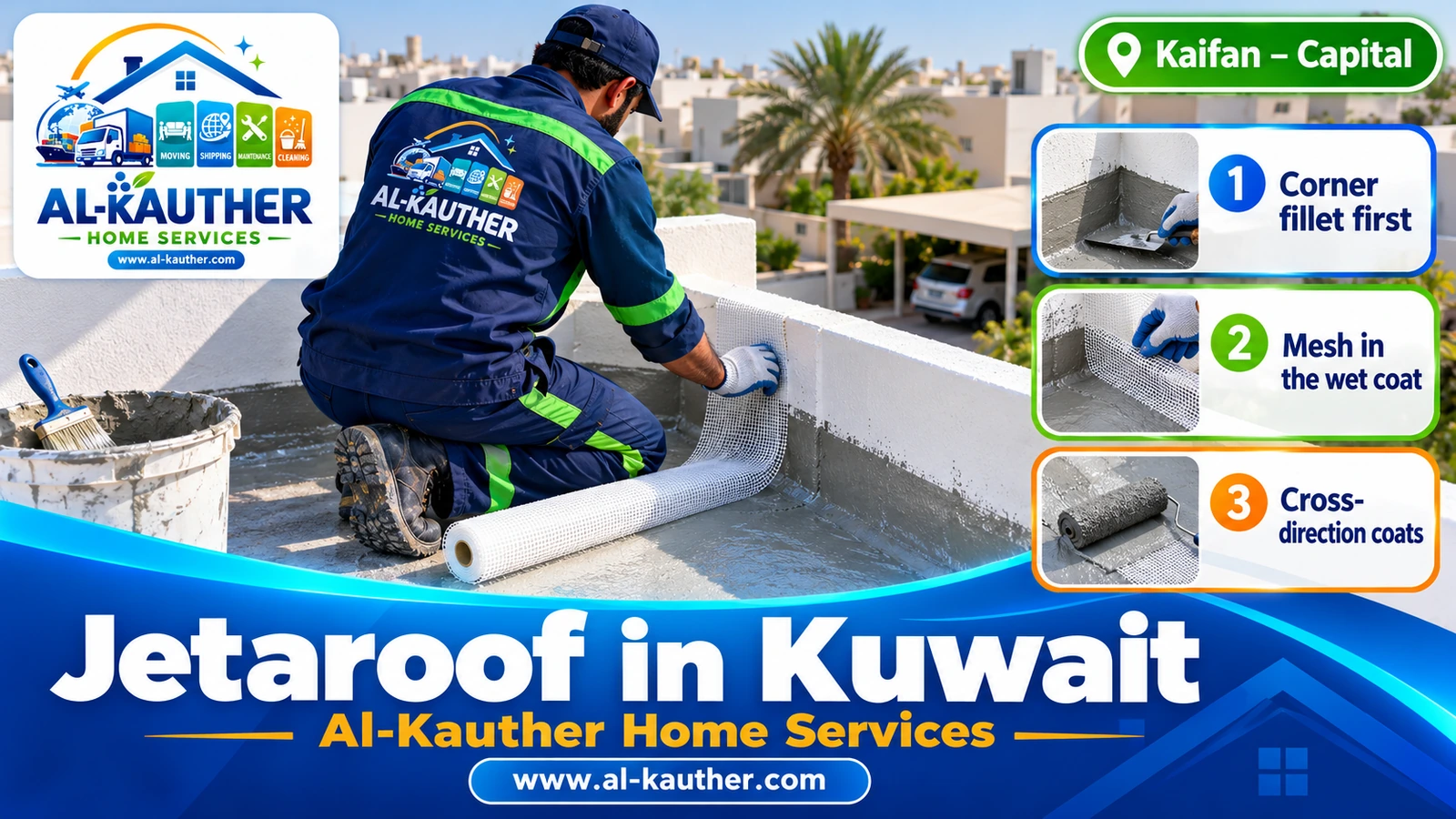
Jetaroof system layers, bottom to top
- Primer: a thinned coat that soaks into the concrete or tile pores and bonds the system to the roof.
- Local repairs: filler or mortar for cracks, and an angled fillet at the corners.
- First coat with fiberglass mesh: the mesh is laid out and pressed into the wet material until it disappears inside it.
- Second and third coats: each applied after the previous one dries, in a crosswise direction, until every pore is sealed.
- Reflective top coat: a silver or white layer that reflects sunlight and protects the acrylic from UV.
How Al-Kauther applies Jetaroof
In summer we start at sunrise and stop before noon, because coating a hot roof makes the material skin over on top before it bonds underneath. The roof is pressure washed and left to dry fully, large cracks are opened and filled, and fillets are formed along walls and parapets. Then come the primer, the first coat with mesh, the following coats once dry, and finally the reflective coat. An average house roof usually takes one to two working days, respecting drying time between coats.
Strengths and limits of Jetaroof
Jetaroof’s main strengths are fast application, no tile breaking on most roofs, easy spot repair if one area is damaged without redoing the whole roof, and heat reflection from its top coat. But it is basically a waterproofing product, not a replacement for true thermal insulation: the reflective coat reduces heat, but it does not do what several centimeters of foam do. It also does not like heavy foot traffic or heavy furniture, and the reflective coat needs renewing every few years depending on sun exposure.
Warning: Jetaroof laid over old insulation that is bubbling or peeling will not last; detached areas must be removed first. And anyone offering “one coat, no mesh” at a very low price is selling you paint, not insulation.
American spray foam insulation in Kuwait: polyurethane foam
American spray insulation in Kuwait means spraying polyurethane with a dedicated machine so it expands on the roof as foam and hardens within minutes, giving thermal and waterproof insulation together in one seamless layer. It is usually chosen when the home’s problem is top-floor heat more than leaks, or when the roof is irregular with many pipes and fittings that are hard to work around with boards.
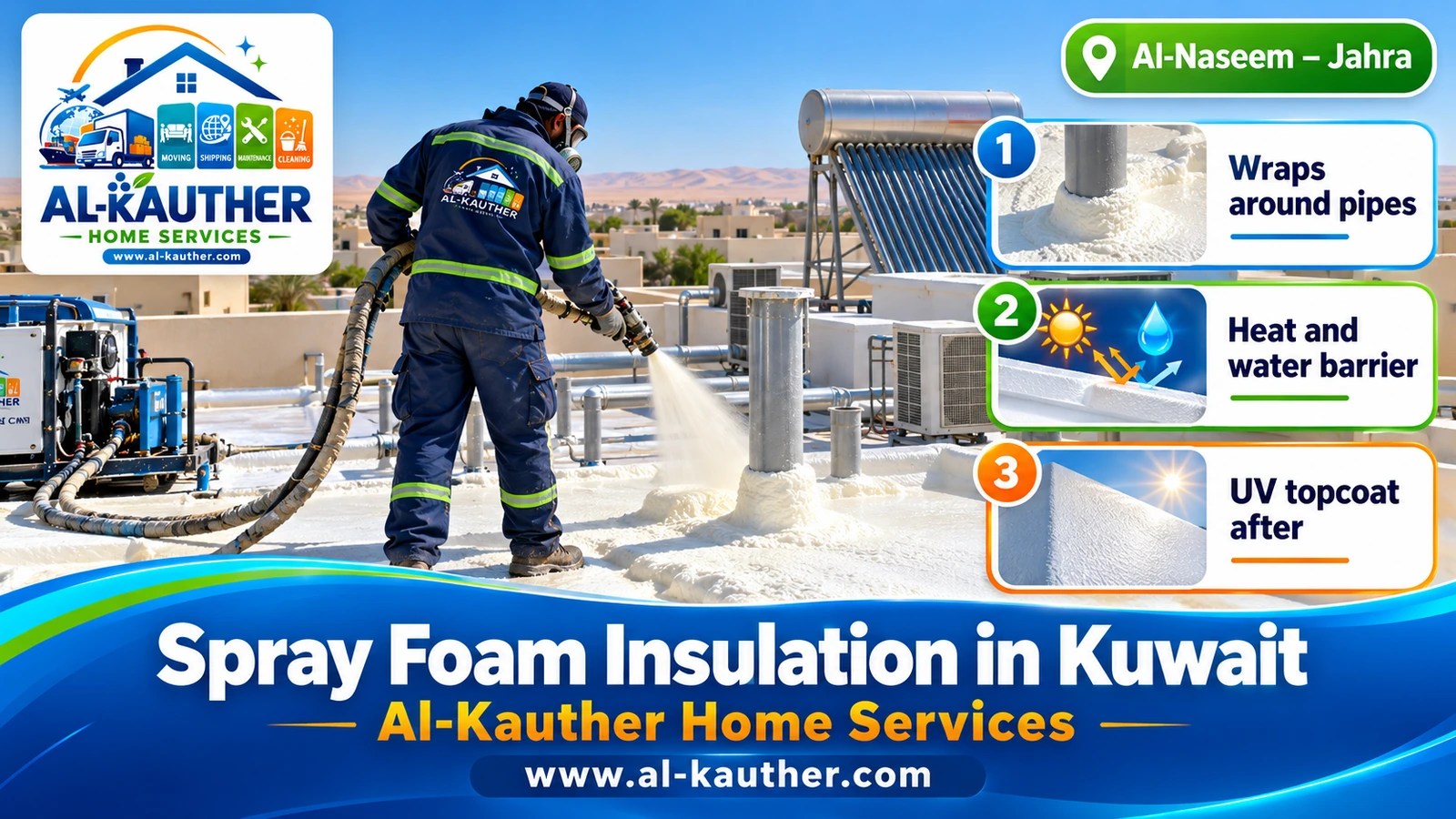
The foam is usually sprayed at 3 to 5 cm depending on the thermal performance needed, then covered with a UV-resistant protective coat, because foam left exposed to the sun turns yellow and then crumbles over time. That final step is what separates spray foam that lasts for many years from foam that starts breaking down after two summers.
When to choose spray foam over Jetaroof
- When the main complaint is top-floor heat and the electricity bill, not only leaks.
- On roofs crowded with fittings: solar pipes, tank stands, ducts and vents.
- On kirbi and shinko metal roofs and annexes that heat up like an oven.
- For external thermal insulation of rooftop water tanks.
If the roof is flat and tiled and the problem is only scattered damp, Jetaroof is usually enough at a lower cost.
Jetaroof, spray foam or bitumen? A direct comparison
The core difference is that Jetaroof is flexible waterproofing applied on top of the roof, spray foam is thermal and waterproof insulation together, and bitumen is traditional waterproofing best placed under tiles. This table sums up what matters when choosing:
| Comparison | Jetaroof | Spray foam | Bitumen membrane |
|---|---|---|---|
| Type | Waterproof with sun reflection | Thermal and waterproof | Waterproof |
| Typical thickness | 1 – 1.5 mm | 3 – 5 cm | 3 – 4 mm per roll |
| Over existing tiles | Usually yes | Yes | Better under tiles |
| Foot traffic | Light | Medium with protective coat | Good when tiled over |
| Maintenance | Renew reflective coat periodically | Renew protective coat | Low when covered |
| Time for an average roof | 1 – 2 days | About 1 day | 1 – 2 days |
| Starts from (KWD/m²) | 4.4 | 3.6 | 2.55 |
Bitumen waterproofing: membrane rolls, cold and hot bitumen
Bitumen is the oldest and most widely used waterproofing under tiles in new Kuwaiti homes. It comes as rolls torched onto the roof, as a liquid brushed on cold, or hot, melted and poured. Rolls are laid on a primed surface, their edges torched together with a lap of no less than 10 cm, then turned up the walls and parapets high enough that water cannot enter at the corner.
Cold bitumen (emulsion) suits small areas, bathrooms and foundations, while hot bitumen is used on large projects. The drawback of exposed bitumen is that the sun degrades it and it softens in extreme heat, so it must be covered with tiles or a protective layer; otherwise Jetaroof or foam suits an exposed roof better.
Thermal roof insulation: boards, wool, perlite and foam concrete
Thermal insulation for a roof in Kuwait means placing a heat-resisting material between the concrete slab and the tiles, usually on new homes or when the roof tiles are being replaced entirely. The main materials are:
- Extruded polystyrene boards: light boards that do not absorb water, laid over the waterproofing and under the protective screed. From 2.9 KWD/m² installed.
- Rock wool and glass wool: fire resistant, used more in false ceilings, walls and pipe lagging than on exposed roofs.
- Perlite: light granules mixed with cement to form an insulating slope layer.
- Foam concrete (Siltone): lightweight concrete full of air bubbles, poured to form slopes with good thermal performance.
- Polyethylene sheet: a black plastic separation layer that blocks moisture and protects the insulation, but is not enough on its own.
A combined system brings both together: waterproofing (bitumen or Jetaroof), then thermal boards, then screed and tiles, or spray foam topped with Jetaroof. It starts from 5.2 KWD per meter and is the right choice for anyone building a new house or fully renewing a tired roof. Kuwait’s energy conservation code for buildings requires roof thermal insulation in new buildings, so this is not a luxury.
The cheapest way to insulate a roof in Kuwait: when cheap is costly
In Kuwait, bitumen membrane is the lowest-cost roof insulation, followed by two-coat Jetaroof, but the lowest price per meter can become the most expensive after two years if it is chosen for the wrong situation. Exposed bitumen without protection breaks down in the sun, and single-coat Jetaroof without mesh cracks in the first summer.
Practical advice: if the problem is leaks in a tiled roof with sound slopes, properly applied Jetaroof is the economical answer. If the problem is heat and leaks together, spray foam saves you two separate systems. And if you are breaking the tiles anyway, take the chance to install a full combined system under the new tiles.
The best roof insulation in Kuwait: the answer starts with your roof
For a Kuwaiti home, the right roof insulation is whichever system answers your roof’s specific problem, not a single material for every house. To make the decision easier, these are the cases we see most often:
- Older tiled house with scattered leaks: three-coat Jetaroof with full mesh and reflective coat.
- Very hot top floor with little leaking: spray foam with a protective coat.
- House under construction: combined system: bitumen + thermal boards + screed + tiles.
- Annex or garage with a metal roof: spray foam inside or outside depending on the design.
- Roof crowded with equipment and pipes: spray foam, because it wraps around everything without joints.
Searches like “strongest insulator” or “Kuwaiti insulator” usually revolve around brand names; the real test is the product specification, the applied thickness and how well the details are handled.
Send photos and the size of your roof, and we will suggest the right system and its cost before the visit
Call 65550977 WhatsAppThe weak points where insulation fails
Most leaks on insulated roofs in Kuwait come not from the middle of the roof but from its edges and details: corners, drains, AC and tank bases, and the stairwell door threshold. That is why we spend more time on these points than on coating the open area itself.
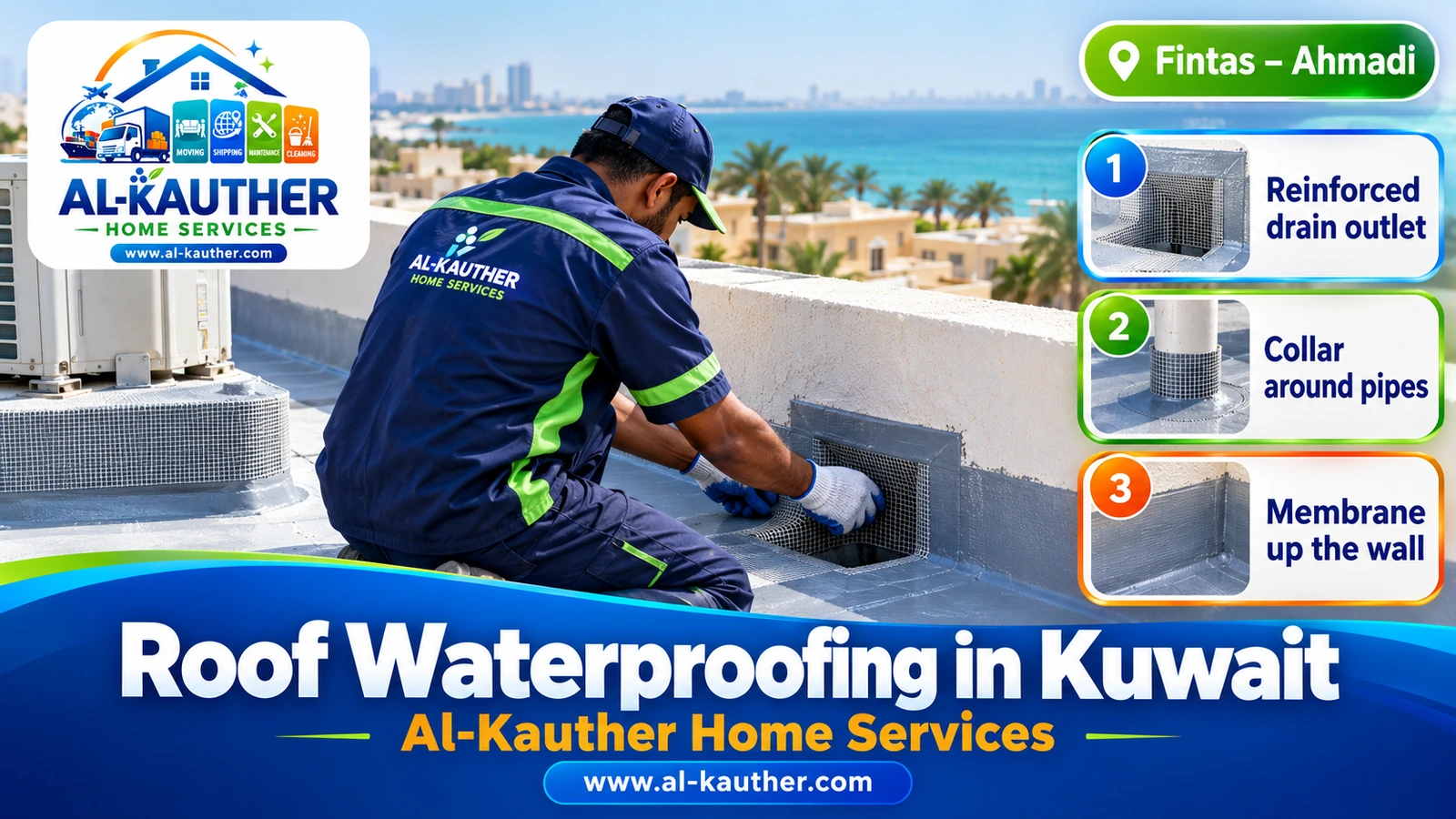
- Drains: we clean the outlet, run the membrane into it with an extra piece of mesh, and make sure water reaches it instead of stopping short.
- Floor-to-parapet corner: an angled fillet, then the membrane turned up the wall above the height that ponding water can reach.
- AC bases: sealing around the base and piping condensate to the drain instead of letting it drip on the roof.
- Tank stands: checking the float valve and overflow first, then sealing around the base. Tank problems themselves are covered in our guide to tank repair and maintenance in Kuwait.
- Roof door threshold: running the membrane under the threshold so water does not enter the stairwell.
- Pipes and penetrations: a collar of mesh and membrane around every pipe.
Thickness checks and ponding tests: what you receive on the last day
The customer receives the roof after three checks: thickness, adhesion and, where the roof allows it, a ponding test. A roof that looks shiny from a distance is not enough.
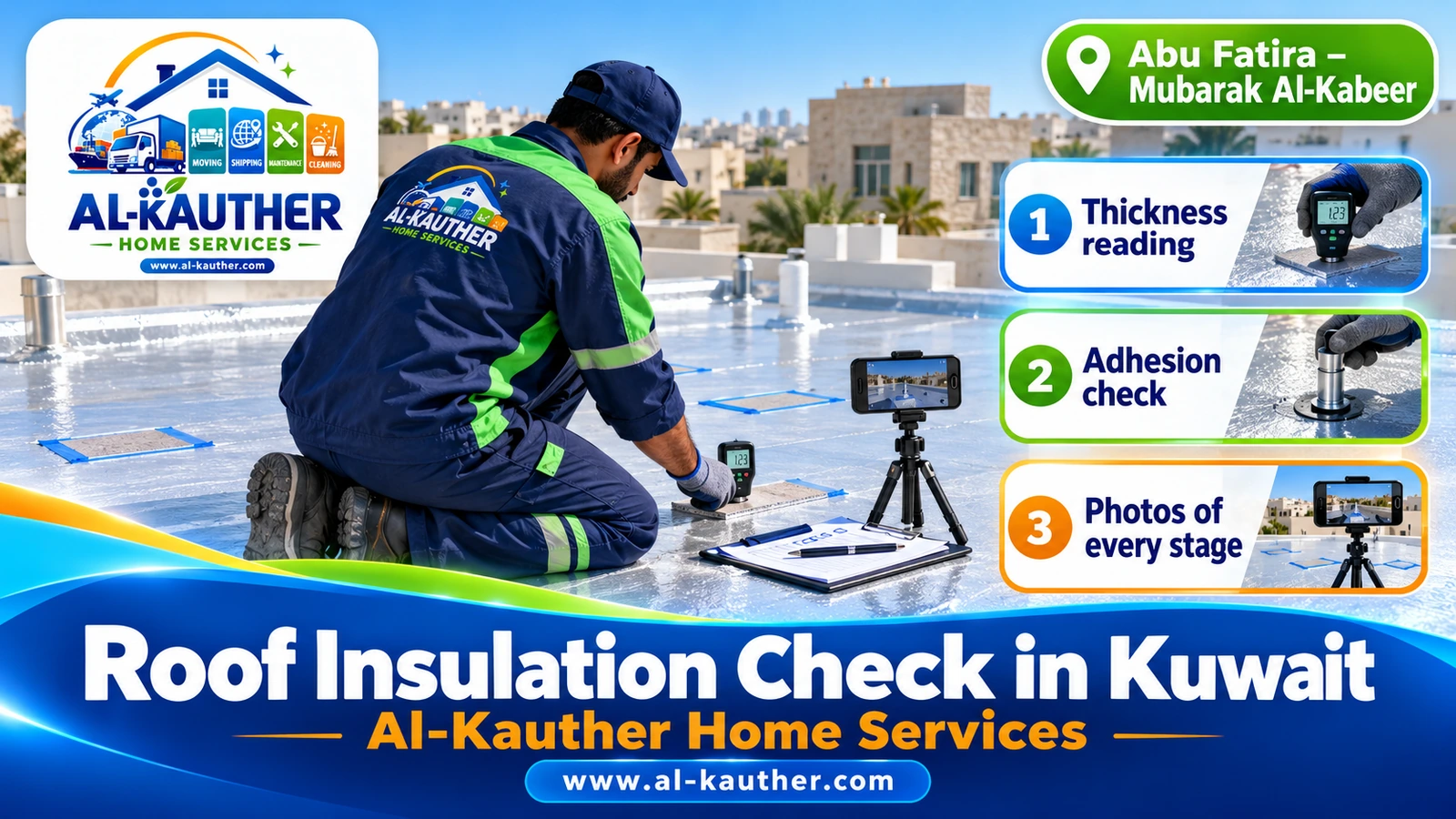
- Thickness: a small sample or a thickness gauge at several points; it must not be below the agreed specification.
- Adhesion: no bubbles and no lifted edges, especially at corners and drains.
- Ponding test: drains are temporarily plugged and the roof is flooded for 24 to 48 hours, then the ceiling is checked inside. Done only on roofs that can carry the water load and after the membrane is fully cured.
- Cleanliness: removing waste, empty buckets and material residue from the roof and stairs.
Tip: Ask for photos of each stage before it is covered by the next: the cracks after filling, the mesh before the second coat. Those photos are your proof that the hidden work was done as agreed.
Thermal insulation for rooftop and ground water tanks in Kuwait
Thermal insulation for a water tank in Kuwait reduces how hot the water in a roof tank gets in summer, and is usually done by spraying polyurethane foam on the tank’s outer surface and then a protective coat. It is a common request because roof tanks in Kuwait sit in direct sun for long hours, so water reaches the taps hot.
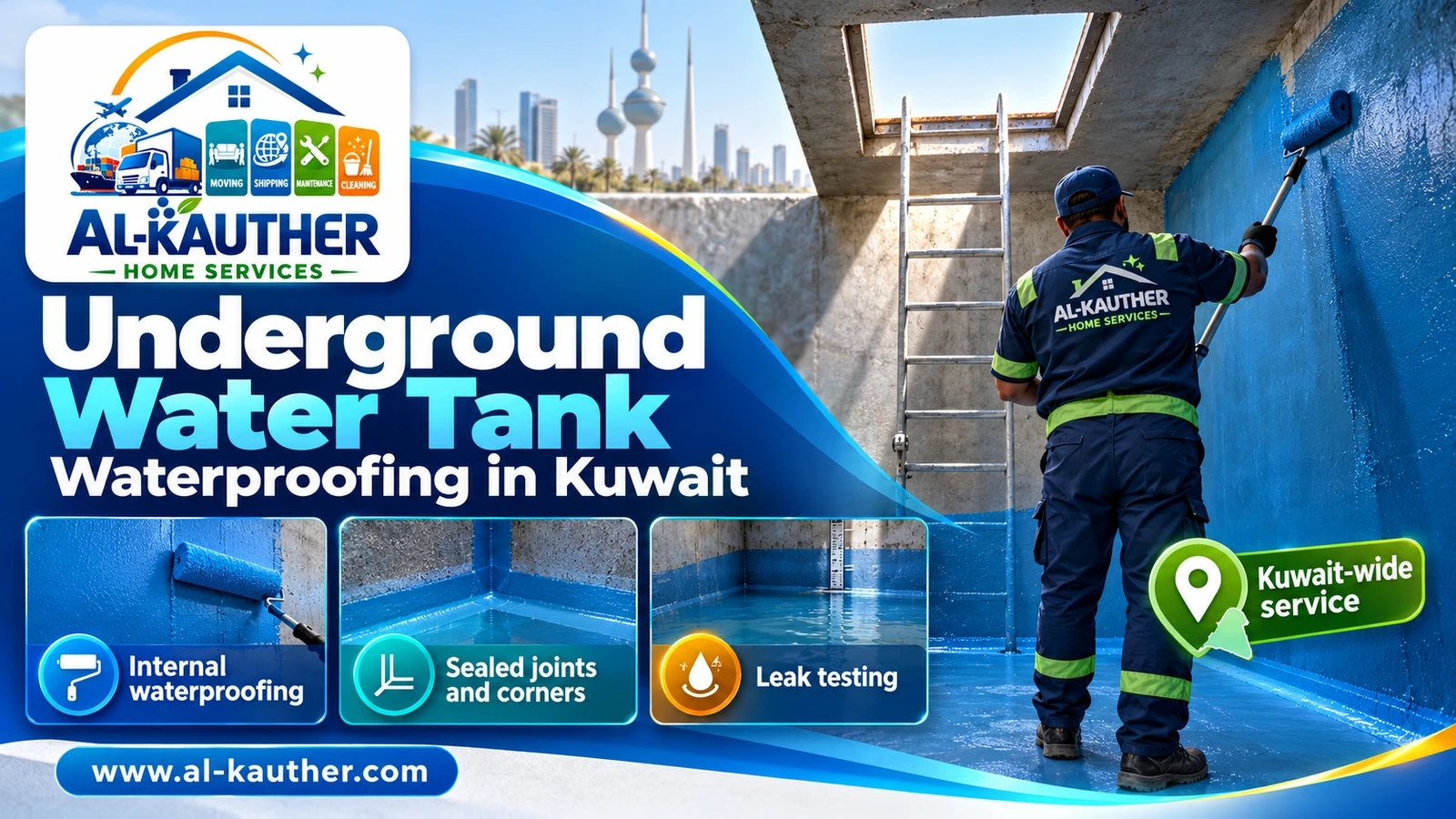
Insulation slows heat gain but does not chill the water; if you want genuinely cold water, the answer is a tank cooling unit, explained in our guide to tank water coolers in Kuwait. A ground tank usually needs no thermal insulation, but rather internal waterproofing if it is concrete and seeping, using drinking-water-safe materials only. Any tank must be cleaned before internal work, as covered in tank cleaning and washing in Kuwait.
External tank insulation is priced by the tank’s outer surface area at the spray foam rate, starting from 3.6 KWD per square meter. If the tank is old and cracked, replacing it may be the better deal; see the options in water tanks for sale in Kuwait.
Insulating kirbi and shinko roofs, garages and annexes
Kirbi and shinko roof insulation in Kuwait is mostly done by spraying polyurethane foam on the metal sheets from outside or inside. It stops rain leaking through screws and joints and cuts the heat that makes an annex unusable in summer. It starts from 3.6 KWD per meter.
Spraying outside protects the metal from rust and covers the screws, but needs a sun-protective coat. Spraying inside keeps the outer roof look and stops condensation on the metal when the AC runs. We decide which suits you after seeing the roof, how it is fixed and how many joints it has.
Waterproofing pools, bathrooms, kitchens and clear sealer over tiles
Pool and bathroom waterproofing in Kuwait is done before tiling, using flexible cementitious or bitumen-based products that tolerate constant immersion. In a pool the whole basin is waterproofed and water-tested before tiling; in bathrooms and kitchens the floor is treated and the membrane turned up the walls around the shower and sink. Pool waterproofing is priced after photos and the basin size.
A clear sealer over tiles is a colorless liquid brushed onto tiles and ceramics to seal pores and grout lines without changing the look. It works on balconies, terraces and tiled roofs where water seeps only through the grout lines, but it does not fix cracks in the concrete beneath, and it does not replace full insulation on a tired roof.
How long does roof insulation last? A maintenance schedule
A Kuwaiti roof membrane gives long service if it goes on at the correct thickness and gets regular care: Jetaroof needs its reflective coat renewed periodically, spray foam needs its protective coat, and bitumen under tiles outlasts them all. What shortens insulation life most is neglect, not the material.
| When | What to check | What to do |
|---|---|---|
| Every 6 months | Reflective coat, corners and AC bases | Spot-repair any small peeling |
| Before the rainy season | Drains and outlets | Clear sand, bags and leaves |
| After every heavy rain | The ceiling inside and any ponding | Photograph any stain and contact us right away |
| After installing any equipment | The base and fixing points | Re-seal the new holes |
| Every few years | Shine of the reflective or protective coat | Renew the top coat before the layers beneath suffer |
After the job we stay in touch: if a leak appears in the insulated area within the period agreed in writing when you sign, we come back and redo the treatment. The only condition is that the roof has not been drilled after insulation to fit equipment or a dish without re-sealing that spot.
How to compare roof insulation companies in Kuwait
Compare roof insulation companies by specification, not price alone: ask about the number of coats, the final thickness, whether mesh is used, how corners and drains are handled, and whether the reflective coat is included. These are questions we wish every customer asked every company, including us:
- How many coats will be applied, and what is the final thickness in mm or cm?
- Is the mesh laid over the whole roof or only over cracks?
- Who removes failed old insulation, and is it in the price?
- How will drains, AC bases and tank stands be treated?
- Is there a ponding test or thickness check at handover?
- How long is the follow-up after the job, and what exactly does it cover?
Any price far below the market without explanation, or promises of fantastic insulation lifespans, deserves an extra question before you sign.
Roof insulation areas across Kuwait’s governorates
Al-Kauther carries out roof insulation, Jetaroof and spray foam in all six governorates of Kuwait, and the crew arrives with equipment and materials at the agreed time:
- Capital Governorate: Shamiya, Shuwaikh Residential, Kaifan, Khaldiya, Yarmouk, Rawda, Adailiya, Dasma, Qadsiya, Mansouriya, Faiha, Nuzha, Daiya, Qurtuba, Surra.
- Hawalli Governorate: Salmiya, Jabriya, Rumaithiya, Mishref, Bayan, Salwa, Shaab, Hateen, Zahra, Siddiq, Salam, Shuhada.
- Farwaniya Governorate: Farwaniya, Khaitan, Ardiya, Andalous, Rabiya, Rehab, Omariya, Ishbiliya, Jleeb Al-Shuyoukh, Abdullah Al-Mubarak, Sabah Al-Nasser.
- Mubarak Al-Kabeer Governorate: Sabah Al-Salem, Qurain, Qusour, Adan, Messila, Abu Fatira, Fnaitees, Abu Al-Hasaniya, Masayel.
- Ahmadi Governorate: Fahaheel, Mangaf, Abu Halifa, Fintas, Mahboula, Riqqa, Hadiya, Sabahiya, Egaila, Dhaher, Sabah Al-Ahmad Residential, Khairan.
- Jahra Governorate: Jahra, Saad Al-Abdullah, Naseem, Oyoun, Qasr, Waha, Taima, Naeem, Jaber Al-Ahmad, Mutlaa.
How to order roof insulation from Al-Kauther
Ordering roof insulation from Al-Kauther takes five simple steps, starting with a WhatsApp message and ending with a tested, handed-over roof:
- Send photos of the roof, the ceiling inside and the approximate area on WhatsApp 65550977.
- We reply with the suggested system and an initial cost, and book an inspection if needed.
- At the inspection we measure and confirm the final price and duration before any work.
- The crew works in the early morning hours in summer, with photos of every stage.
- We hand over the roof after testing, with a maintenance schedule and the written follow-up period.
If you have other work planned on the same roof, such as a central water filter or a pump for the roof tank, it is better done before the insulation, not after; see our guide to central water filter installation in Kuwait.