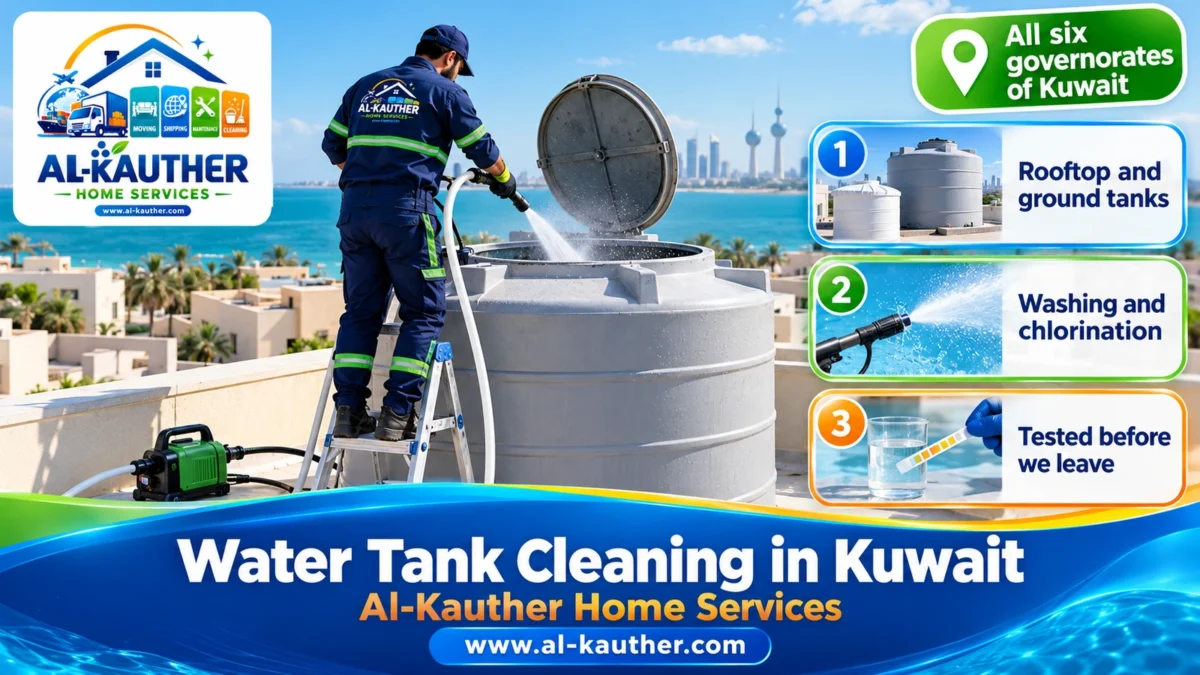
Water tank cleaning and washing in Kuwait is a service Al-Kauther Home Services provides for rooftop tanks and ground tanks in all six governorates: we drain the tank, remove the sediment and silt from its floor, scrub its walls, ceiling and lid, rinse it, then disinfect it with a measured chlorine solution and test the chlorine in your tap water before we leave. Washing a tank up to 1,000 litres starts from KWD 4.750, washing with full disinfection from KWD 13.750, and a house ground tank from KWD 22.500. To reach us, call or WhatsApp 65550977.
In this guide we explain what actually builds up inside a tank that has not been washed for months, how to tell your tank has reached that point, what we do step by step for rooftop and ground tanks, which materials and concentrations we disinfect with and why, how long the job takes and what it costs, and how to keep the water clean for as long as possible afterwards.
In short
- Service: draining, sediment removal, scrubbing walls, ceiling and lid, pressure rinsing, chlorine disinfection, refilling, chlorine testing at the taps, and a short report on the tank’s condition.
- Prices: tanks up to 1,000 litres from KWD 4.750, 1,000 to 3,000 litres from KWD 7.250, over 3,000 litres from KWD 11.250, washing with full disinfection from KWD 13.750, ground tanks from KWD 22.500, building tanks from KWD 45.
- Time: two to four hours for a household tank, longer for ground tanks and large tanks.
- Coverage: Capital, Hawalli, Farwaniya, Ahmadi, Jahra and Mubarak Al-Kabeer.
- Hours: every day, 8 am to 10 pm.
- To reach us: phone or WhatsApp 65550977.
What builds up inside a water tank that is not washed?
A water tank that is not washed collects a layer of sand and silt on its floor and a slimy bacterial film, known as biofilm, on its walls, and algae can grow inside it if light gets in. These layers change the taste and smell of the water and use up the chlorine in it, so the water reaches your tap with less protection than it had when it left the network.
The sources of this dirt in a Kuwaiti home are well known: dust from storms that gets in through the vent and a loose lid, fine particles that arrive with the water itself and settle over time, rust flakes from old fittings and pipes, and insects that find their way through any open gap. In light-coloured or partly translucent tanks, light gets in and green algae grow on the walls, especially in the summer heat that speeds all of this up.
Worth knowing: The water that reaches your home from the network is treated and carries a level of chlorine that protects it, but that level drops the longer the water sits in a warm, dirty tank. So the network water can be fine while the water at your tap is poorer, because of the tank alone.
Signs your tank needs washing now
A tank needs washing straight away if the colour, taste or smell of the water changes, if grains of sand show up in tap and shower filters, or if you see small creatures in the water. These are the main signs and what they usually point to:
- Cloudy or yellowish water: sediment stirred up by water rushing into a tank with a silted floor, or rust from iron fittings.
- A musty or rotten-egg smell: bacterial activity in the sediment, especially when the water has been standing for a long time.
- An earthy or metallic taste: algae or rust.
- Sand in tap aerators and the shower head: a layer of sand on the floor being drawn out with the water.
- Green on the tank wall or in the water: algae growing because of light.
- Worms, larvae or insects: an open gap or a damaged lid; the tank needs washing, disinfection and a sealed lid together.
- Slimy walls: a bacterial film that only comes off with scrubbing.
Warning: If you find a dead animal in the tank or worms in the water, stop using the tank water for drinking and cooking until it has been washed and disinfected, and use bottled water for now.
What does Al-Kauther’s tank cleaning and washing service include?
Al-Kauther’s water tank cleaning and washing service in Kuwait covers everything needed to bring the tank back clean and disinfected inside; structural repairs and part replacement are separate jobs that we tell you about if we notice them. This table sets out the limits so there are no surprises:
| Included in the wash | Not included (separate service) |
|---|---|
| Draining the tank and removing sediment and silt | Welding cracks and holes in the tank body |
| Scrubbing the walls, floor and ceiling inside | Replacing the float valve, valves or fittings |
| Cleaning the lid, vent and any internal ladder | Replacing a damaged lid or fitting a new one |
| Pressure rinsing and removing the rinse water | Lining a ground tank from inside |
| Disinfection with a measured chlorine solution | Running new pipes outside the tank |
| Refilling and testing residual chlorine at the taps | Installing central filters or tank coolers |
| A short report on the tank and what we noticed |
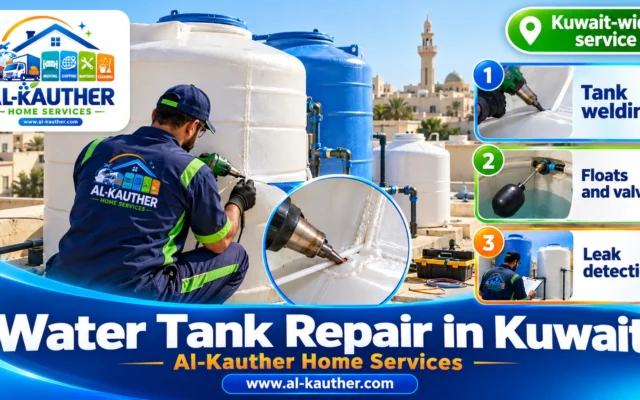
If we spot a crack, a leak or a float valve that will not close during the wash, we photograph it, show it to you and tell you the repair cost, and it can be done on the same visit if you wish. You will find details of this work in water tank repair in Kuwait and water tank welding in Kuwait.
Our tank washing stages, in order
Our tank wash goes through ten stages and we skip none of them, because each stage serves the next: disinfection does not work on a dirty wall, and refilling is not right until the disinfection water has been removed.
- Agreeing with the household: we set a time that suits your water use and suggest filling enough clean containers for the working hours.
- Shut-off: we close the inlet valve and switch off the pump so it does not run on an empty tank.
- Draining: remaining water is used where possible, and the rest is pumped out with a submersible pump.
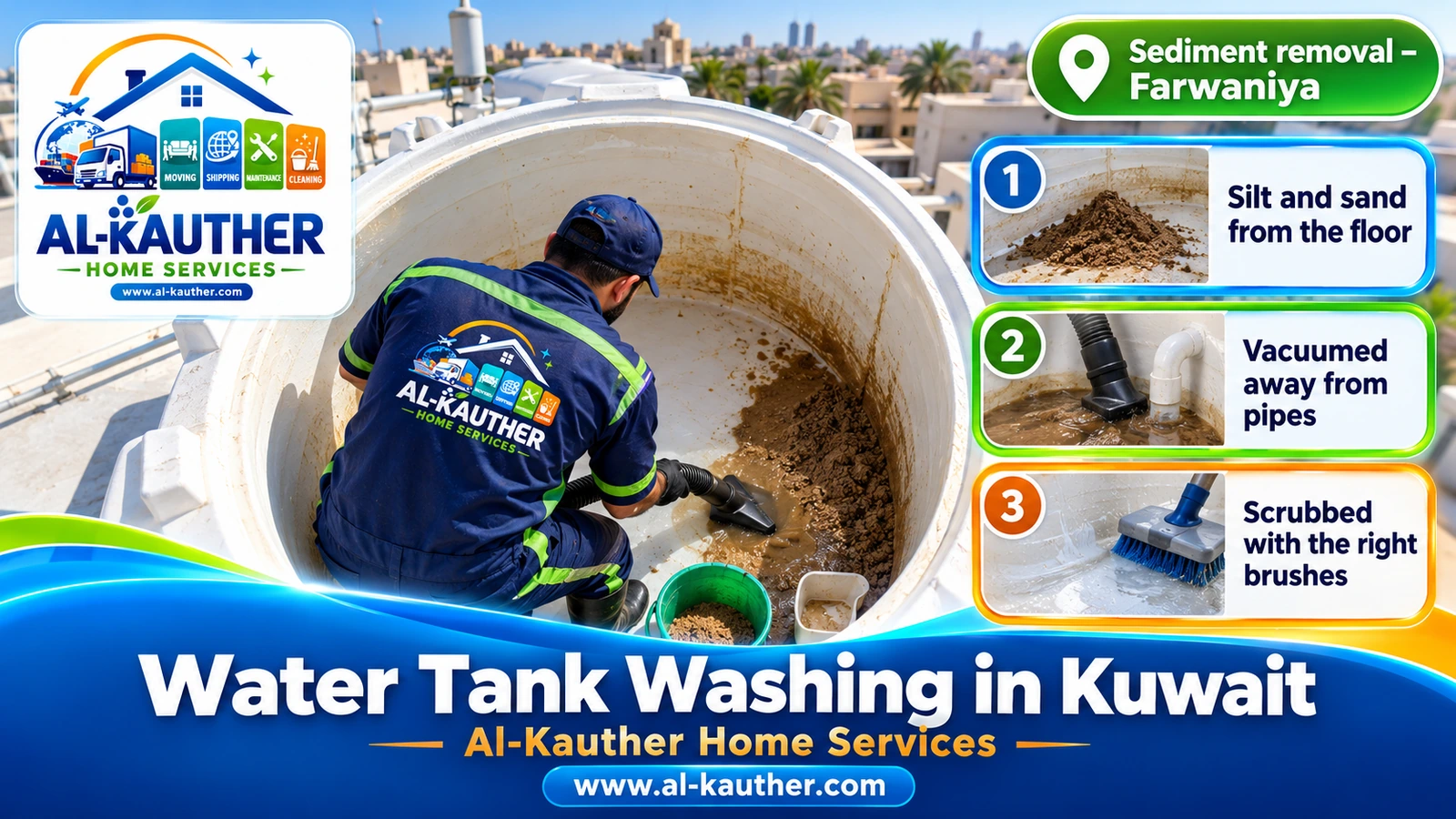
- Sediment removal: silt and sand are gathered from the floor by hand and vacuumed out, never pushed into the house pipes.
- Scrubbing: walls, floor and ceiling are scrubbed with brushes suited to the tank material until the slime and algae are gone.
- Rinsing: we rinse with water at a controlled pressure and remove the dirty rinse water.
- Disinfection: chlorine solution is sprayed on every inside surface, or part of the tank is filled with chlorinated water, and left for the required time.
- Draining and refilling: the concentrated disinfection water is removed, then the tank is refilled from the network.
- Testing: we run the taps until the new tank water reaches them and measure the residual chlorine.
- Closing and report: we secure the lid and the vent screen and give you a summary of what we found and when the next wash is advised.
Tank disinfection: material, concentration and contact time
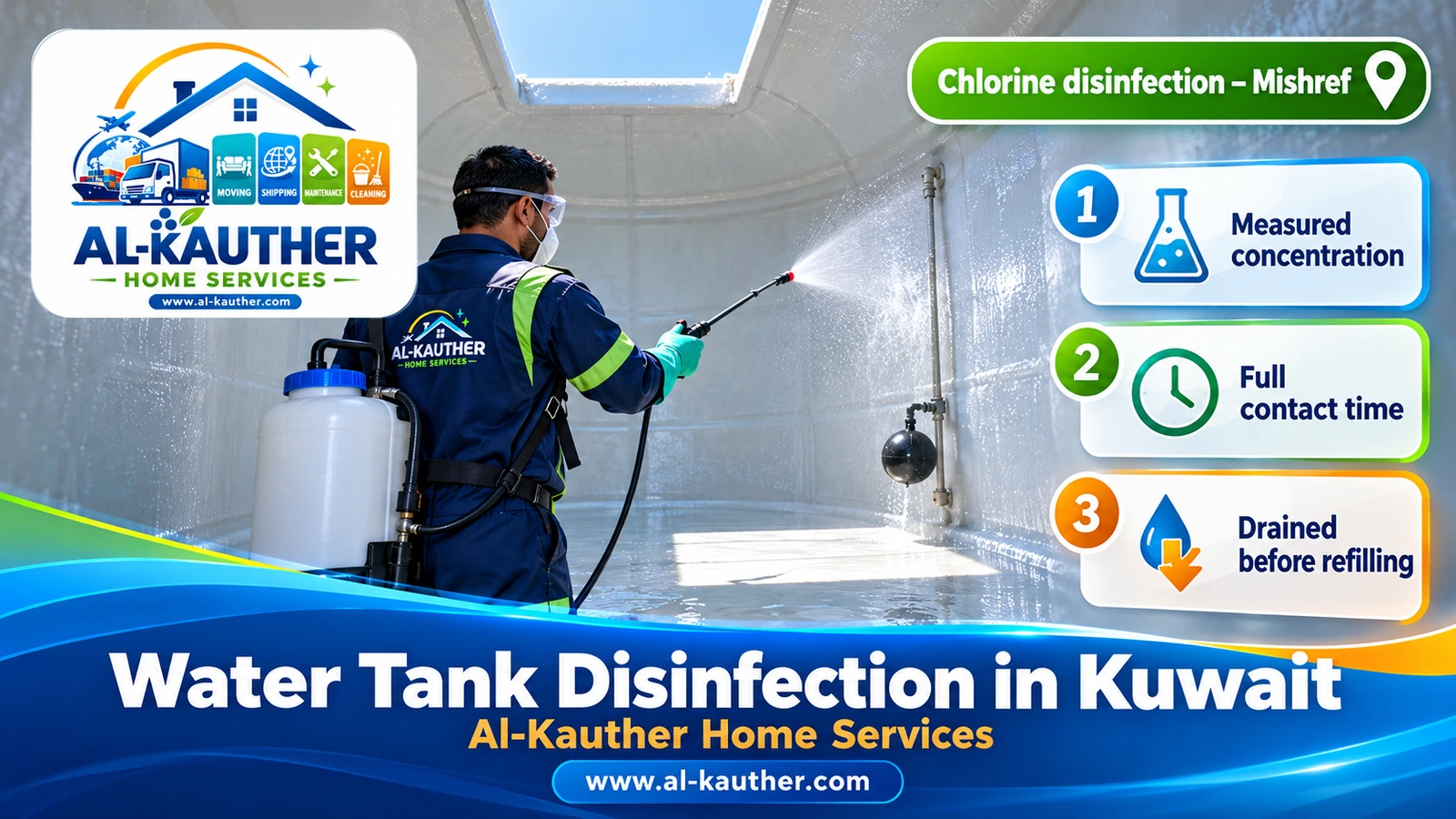
We disinfect water tanks with chlorine, the material used worldwide for disinfecting drinking-water storage, but the result depends on two things: the right concentration and enough contact time with the surfaces. Too little chlorine does not reach what lives in the biofilm, and too much leaves a taste and smell and needs longer rinsing.
Reference guidance for disinfecting drinking-water tanks sets out specific methods, and we choose the one that suits the tank size:
| Method | Concentration and contact time | Suits |
|---|---|---|
| Spraying or wiping surfaces | A solution of about 200 mg/L kept on the walls for at least 30 minutes | Household rooftop tanks after scrubbing |
| Partial fill | About 5% of tank volume at 50 mg/L for 6 hours, then filling up | Ground tanks and large tanks |
| Full fill | At least 10 mg/L in the full tank for a period of up to 24 hours | New tanks or after heavy contamination |
After disinfection we remove the concentrated water and do not let it reach the taps, then we refill and test. A suitable residual chlorine level in tap water is roughly 0.2 to 0.5 mg/L, which protects the water without an unpleasant taste.
Will the water taste of chlorine after disinfection?
You may notice a faint chlorine smell in the first few hours after disinfection; this is normal and fades as the water is used and fresh water comes in. A strong taste that lasts more than a day means the disinfectant was not drained properly, which is exactly what we avoid by testing the chlorine before leaving.
Things we never put in a drinking-water tank
- Scented detergents and washing-up liquid, because they leave foam and smells that are hard to rinse off the walls.
- Strong acids and industrial descalers, because they harm plastic tank walls and fittings.
- Chlorine mixed with any acid or with ammonia, because mixing releases toxic gases in an enclosed space.
- Insecticides of any kind inside the tank.
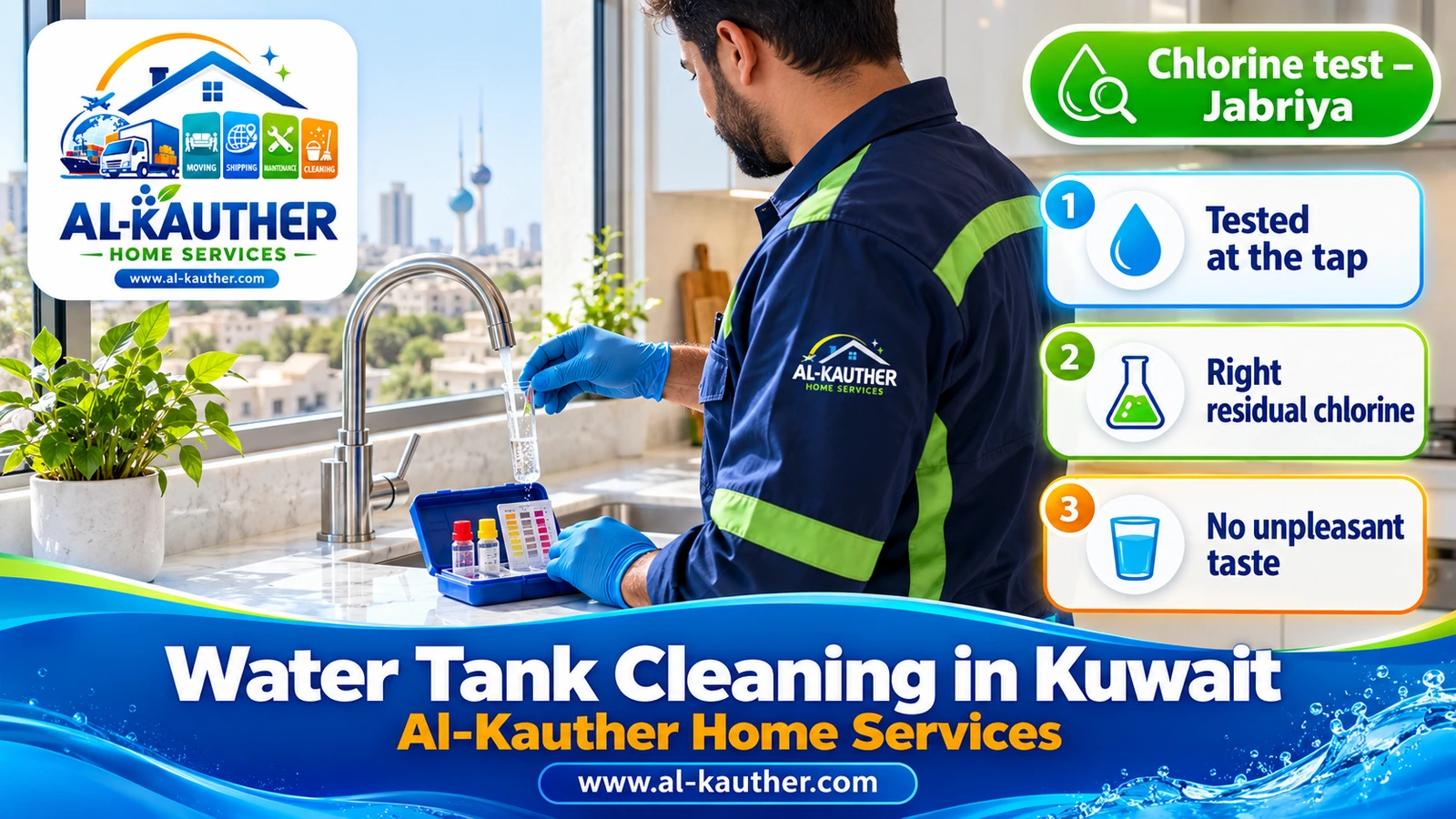
Rooftop tank washing in Kuwait
Washing a rooftop tank in Kuwait is quicker than washing a ground tank because it is easier to reach and usually smaller, but it needs washing more often because it takes the sun and dust directly. In summer we schedule it for the morning or late afternoon, because working on an open roof at midday exhausts the worker and dries the disinfectant on the walls before its time is up.
In homes with more than one tank on the roof, we wash them one after another so the whole house is not without water, or together if the family has stored enough. A partly translucent or light-coloured tank needs extra attention for algae, and we suggest shading it or fitting an opaque cover after the wash.
Ground tank washing in Kuwait
Washing a ground tank in Kuwait is confined-space work, so safety comes before everything: we open the hatch and ventilate the tank before going in, and the worker only enters on a safety line with a colleague who stays at the hatch the whole time, with low-voltage lighting that is safe around water.
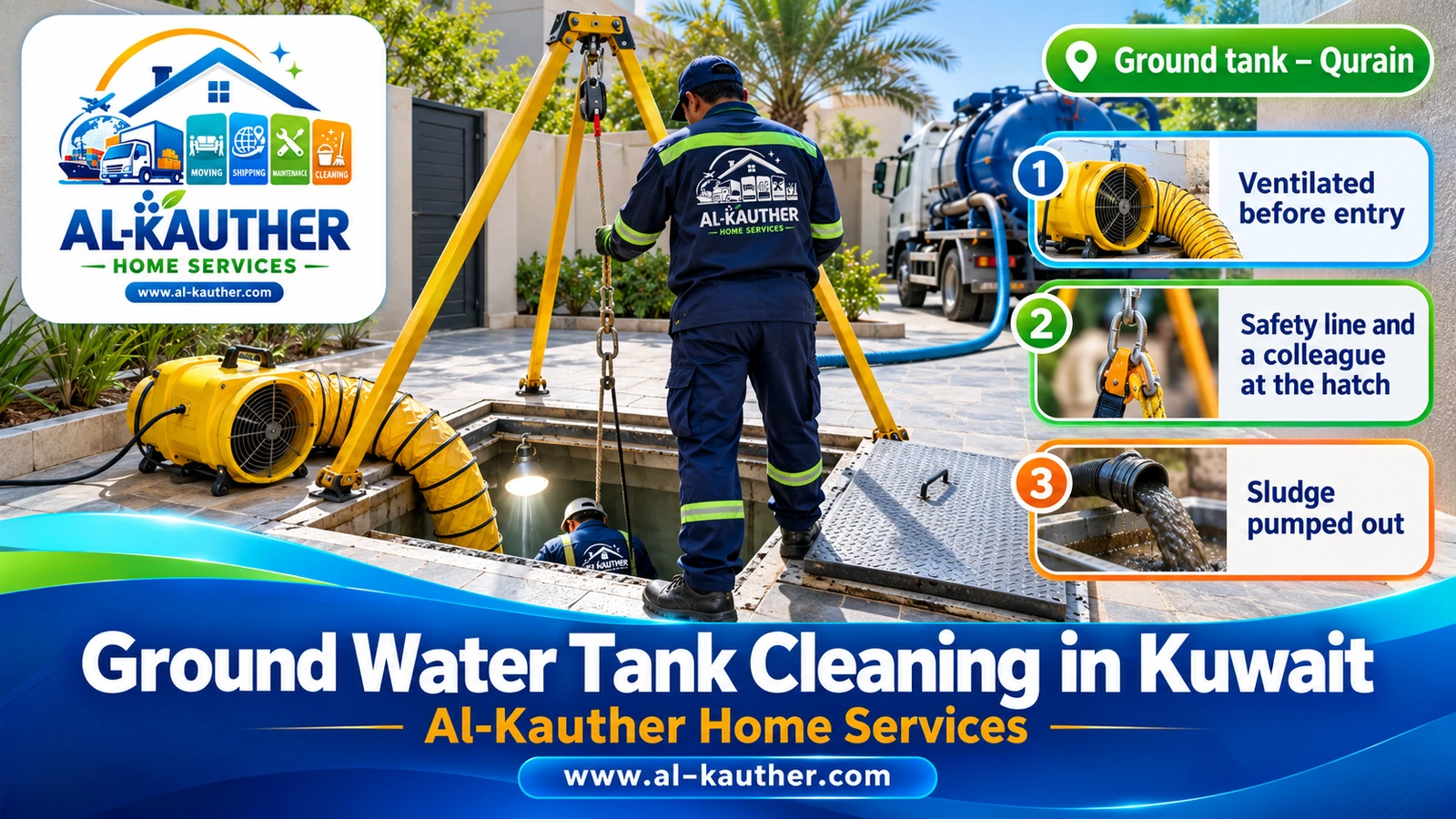
A ground tank collects more sediment than a rooftop tank because it receives the network water first, so most of the silt settles there. We pump the sludge out, scrub the concrete walls with stiffer brushes than those used on plastic tanks, and at the same time check cracks, corners and the area around the inlet: any damp patch from outside or unexpected water seeping in is photographed and reported to you, because a ground tank taking in groundwater or outside leaks needs more than a wash.
After washing we usually disinfect with the partial-fill method because the wall area is large, allow the full contact time, then refill and run the pump to move water up to the rooftop tank, and test the chlorine on the top floor.
Two-compartment tanks and connected tanks
Some ground tanks are split into two compartments, and some homes have two tanks joined by a pipe. Here we wash one compartment while the other stays in use so the water does not stop, then swap. We close the connecting pipe during the work so sediment does not move from the dirty side to the clean one.
How each type of tank is washed
The washing method depends on the tank material, because a brush or pressure that suits a concrete wall can scratch a fiberglass tank or damage the inner layer of a plastic one. This is what we take into account for each type:
| Tank type | What we pay attention to | What we avoid |
|---|---|---|
| Polyethylene (plastic) | Soft brushes, medium water pressure, care with algae in light-coloured tanks | Wire brushes and acids, and high pressure on a sun-worn wall |
| Fiberglass | Gentle scrubbing that keeps the gelcoat intact, checking panel joints | Sharp scrapers that scratch the surface so algae cling later |
| Galvanised iron or steel | Removing loose rust flakes, checking the inner coating | Leaving rust flakes on the floor, and acidic products |
| Concrete ground tank | Stiff brushes, sludge pump, checking cracks and lining | Entering without ventilation and a safety line |
Cleaning a tank of rust, scale and algae
Rust
Cleaning rust from a water tank means removing the loose flakes from the walls and floor and taking them out, not painting over them. If the rust comes from corrosion in the body of an iron tank, washing only improves the water for a while, and the wall needs treatment or the tank needs replacing. In plastic tanks, rust usually comes from old iron fittings or pipes, and we tell you where it is coming from.
Scale and white deposits
A hard white layer on the tank walls is mineral scale, and we remove it by mechanical scrubbing. We do not use strong acid descalers inside a drinking-water tank, because the harm to the wall and fittings outweighs the benefit.
Algae
The way to clean algae from a water tank is to scrub until the green layer is gone from its roots and then disinfect, but algae will come back as long as light gets into the tank. So we suggest a fix for the light as well: an opaque cover, shading, or replacing a translucent tank with a multi-layer one at the first opportunity.
The equipment we use for tank washing
- A submersible pump to drain the tank, and a sludge pump for thick sediment.
- A pressure washer with adjustable pressure to suit the tank material.
- Soft and stiff hand brushes, and long-handled brushes for ceilings and corners.
- A wet vacuum for liquids and fine sediment.
- A sprayer for the disinfectant and kits for measuring residual chlorine.
- A safety line, low-voltage lighting and a ventilation fan for ground tanks.
- Gloves, rubber boots, masks and goggles, and clean work clothes used only inside tanks.
Is your tank due for a wash?
Tell us the tank type, size and location on WhatsApp and we will set a time and give you the expected price.
Call 65550977 WhatsAppHow long does tank washing take?
Washing a household tank of up to 1,000 litres usually takes two to four hours including disinfection and contact time, a tank of 1,000 to 5,000 litres four to six hours, and large ground tanks and building tanks may need a full working day. It takes longer when the sediment is heavy or access is difficult.
Approximate times for washing with disinfection by tank size:
| Tank size | Approximate time | Note |
|---|---|---|
| Up to 1,000 litres | Two to four hours | The rooftop tank in most homes |
| 1,000 to 5,000 litres | Four to six hours | A large tank or more than one tank |
| House ground tank | Five hours to a working day | Includes ventilation, safety and sludge removal |
| Building and facility tanks | A working day or more | Done in stages so the water does not stop |
How often should tanks be washed in Kuwait?
Water tanks in Kuwait should be washed at least once every 6 months, and every 3 to 4 months in certain cases. Kuwait’s heat and dust speed up sediment build-up and bacterial growth compared with cooler countries.
We advise shortening the interval to 3 or 4 months in these cases:
- After the dust-storm season, especially if the lid or vent is not well sealed.
- If there are babies, elderly people or anyone with weak immunity in the house.
- For partly translucent tanks where algae grow.
- In restaurants, commercial kitchens, mosques and schools with heavy use.
- If you notice sand in the taps before the scheduled wash.
Times to wash outside the schedule
- Before moving into a new house or flat: you do not know when the tank was last washed.
- After a long trip or a closed-up house: water standing for weeks in the heat loses its chlorine and changes.
- After any repair or welding inside the tank: sanding dust and material residue remain.
- After a long water cut ends: the strong flow after a cut carries sediment from the network.
- When a new tank is installed: it is rinsed and disinfected before first use.
Dust, heat and tall buildings: what makes tank washing in Kuwait different?
Tank washing in Kuwait deals with three things not found to the same degree in many places: storm dust that reaches any poorly sealed tank, summer heat that warms the water in rooftop tanks and speeds bacterial growth, and houses and buildings with high roofs and annexes that make tanks harder to reach.
So in summer we work in the morning and evening hours, carry ladders and equipment suited to high roofs, and pay attention to the vent screen and a tight lid after the wash, because they are the first line of defence against dust. If water temperature is an ongoing problem in your home, you will find solutions in water tank cooler installation.
Cleaning tanks for buildings, restaurants, mosques and schools
Cleaning tanks in large buildings needs planning before it needs equipment: we agree a schedule with the owner or caretaker to wash the tanks in stages so not every flat loses water at the same time, notify residents in advance of the short interruption, and start with the ground tank before the rooftop tanks.
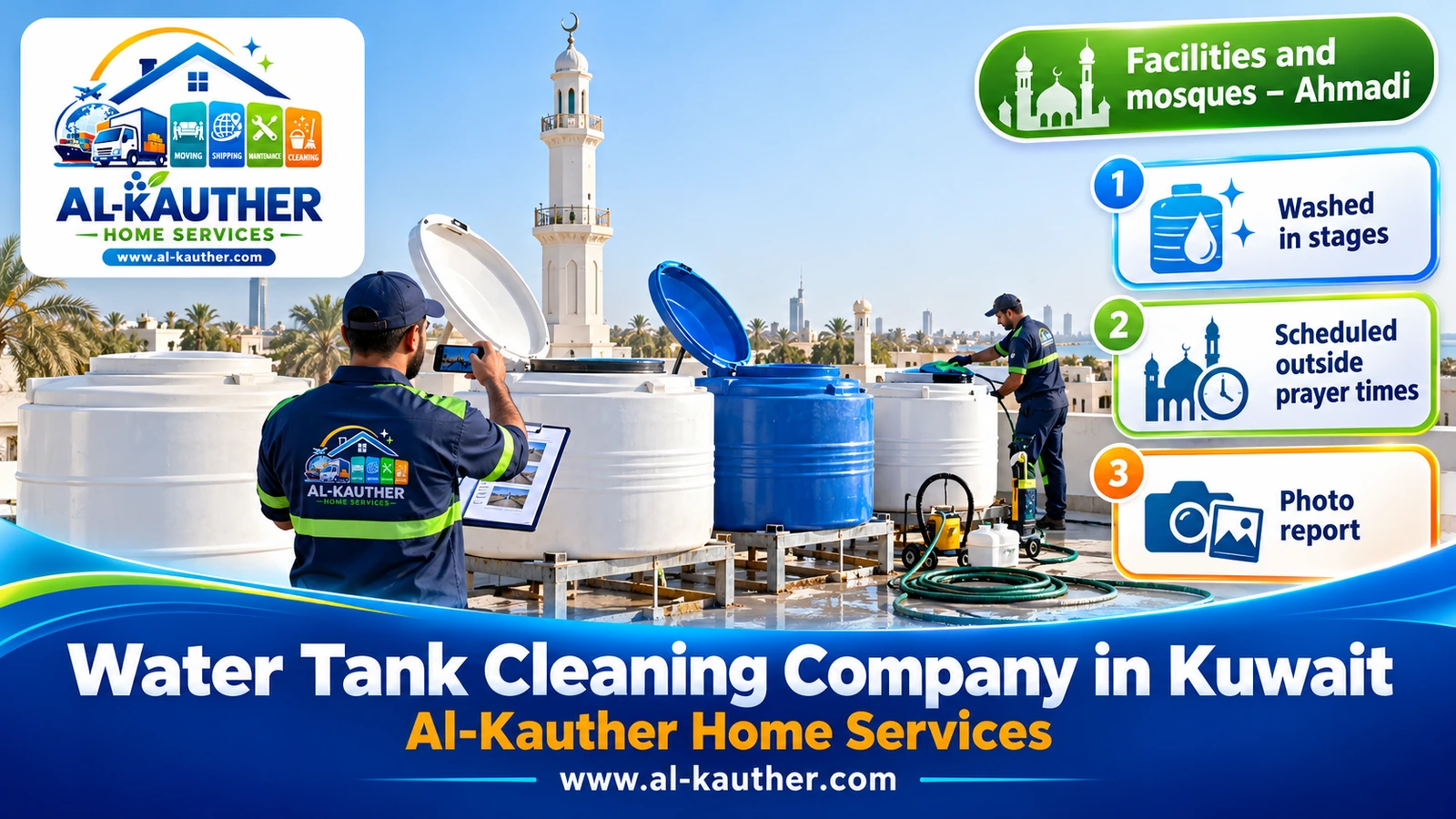
In restaurants and commercial kitchens we arrange the wash outside working hours, because the water goes straight into food. In mosques we avoid prayer times and make every effort to have the water back before the next prayer. In schools we work during holidays and days off. For building owners we provide a short report after each wash with before-and-after photos and the condition of each tank, and a regular washing schedule with fixed dates can be agreed.
Water tank cleaning and washing prices in Kuwait
Al-Kauther’s water tank cleaning and washing prices in Kuwait start from KWD 4.750 for a tank up to 1,000 litres, from KWD 13.750 for washing with full disinfection and chlorine testing, and from KWD 22.500 for a house ground tank. We tell you the price before starting, once we know the size and location.
Starting prices in Kuwaiti dinars by tank type and size:
| Service | What it includes | Starts from |
|---|---|---|
| Washing a tank up to 1,000 litres | Draining, sediment removal, scrubbing, rinsing, refilling | KWD 4.750 |
| Washing a 1,000 to 3,000 litre tank | The same stages for a larger tank | KWD 7.250 |
| Washing a tank over 3,000 litres | The same stages with more time and equipment | KWD 11.250 |
| Washing with full disinfection | All of the above plus chlorine disinfection and chlorine testing at the taps | KWD 13.750 |
| Washing and disinfecting a house ground tank | Ventilation and safety, sludge removal, scrubbing, disinfection, crack check | KWD 22.500 |
| Building and facility tanks | Washing and disinfection in stages with a report | KWD 45 |
What sets the price of a tank wash?
- The size of the tank and the number of tanks on one visit.
- Its type: rooftop or ground, and a ground tank with one compartment or two.
- The amount of sediment: a tank washed six months ago is much quicker than one not opened for years.
- Adding full disinfection and chlorine testing.
- Access: a high annex, a narrow hatch or a tank in a basement.
- Facilities that need the work in stages or outside working hours.
How to get ready for tank washing day
- Store enough clean water for drinking, cooking and ablution during the working hours.
- Know where the main inlet valve and the pump switch are.
- Clear the way to the roof or to the ground tank hatch, and move cars away from a yard hatch if needed.
- If possible, use as much of the tank water as you can before the appointment to shorten draining time.
- Tell us about any particular problem, such as sand in the taps or a smell, so we can focus on it.
Cleaning a water tank yourself: what is fine and what is not
You can clean a small rooftop tank yourself if it is safe to reach: drain it, scrub the walls with a soft brush and water, rinse and remove the rinse water, then refill it. Chlorine disinfection, however, needs the right concentration, contact time and proper draining, and a mistake ends with water that tastes strongly of chlorine or disinfection that killed nothing.
As for a ground tank, we never recommend going into it without ventilation, a safety line and another person at the hatch, because the air in a closed tank can be low in oxygen. Do not mix cleaning products together, and do not use scented household cleaners inside the tank.
How to choose a tank cleaning company in Kuwait
Choose a tank cleaning company that explains the washing and disinfection stages before starting, tests the chlorine after refilling, and follows safety rules for ground tanks. These questions help you tell the difference:
- Do you drain the tank and remove the sediment by hand, or just spray water?
- What do you disinfect with, and how long do you leave it before rinsing?
- Do you test the chlorine at the taps after refilling?
- What safety equipment do you use when entering a ground tank?
- Will you tell me about cracks or faults you notice during the wash?
After washing: how to keep tank water clean for longer
- Keep the lid closed tightly, and replace it if it cracks or loses its seal.
- Fit a fine screen over the vent to keep out dust and insects without blocking airflow.
- Shade the rooftop tank or choose an opaque one; shade slows algae and keeps the water cooler.
- Fit a sediment filter at the tank inlet or a central filter to reduce the sand going in.
- Do not leave the tank standing for weeks; if you travel, have it washed or flushed when you return.
- If the tank is old and cracked, washing will not make up for its condition, and replacement options are listed on our tanks for sale page.
Tank cleaning and washing across Kuwait’s six governorates
Our tank washing teams work across all of Kuwait’s governorates every day between 8 am and 10 pm, grouping visits by area.
Tank washing in the Capital Governorate
Older family homes in Surra, Qurtuba, Yarmouk and Faiha often have both a ground tank and rooftop tanks, so we usually wash them together on one visit. We also cover Kaifan, Shamiya, Adailiya, Khaldiya, Rawda, Qadsiya, Dasma, Doha, Nuzha and Shuwaikh.
Tank washing in Hawalli Governorate
In Salmiya and Hawalli many jobs are building tanks washed in stages, while villas in Mishref, Bayan, Salwa, Rumaithiya and Jabriya are mostly household tanks. Shaab, Zahra, Siddiq, Salam, Hitteen and Shuhada are covered on the same routes.
Tank washing in Farwaniya Governorate
Khaitan, Farwaniya and Jleeb Al-Shuyoukh have many multi-storey buildings with several tanks each; Andalous, Rabiya, Ardiya, Omariya, Rehab, Riggae, Ishbiliya, Ferdous, Sabah Al-Nasser and Abdullah Al-Mubarak are mostly houses.
Tank washing in Ahmadi Governorate
From Fahaheel, Mangaf and Mahboula on the coast to Sabah Al-Ahmad, Jaber Al-Ali, Egaila, Abu Halifa, Fintas, Riqqa, Sabahiya, Hadiya, Dhaher, Ahmadi town and the farms of Wafra, where large tanks need longer visits.
Tank washing in Jahra Governorate
Jahra, Qasr, Oyoun, Naeem, Waha, Naseem, Taima, Qairawan, Sulaibiya, Saad Al-Abdullah and Jaber Al-Ahmad, where newer homes often have large ground tanks under the yard.
Tank washing in Mubarak Al-Kabeer Governorate
Sabah Al-Salem, Messila, Qurain, Adan, Qusour, Abu Fatira, Fnaitees, Masayel, Abu Al-Hasaniya and Mubarak Al-Kabeer itself.
Related tank services from Al-Kauther
- Tank repair and maintenance: for leaks, float valves that will not close and worn fittings found during the wash.
- Tank welding: for cracks and holes in plastic and fiberglass tank bodies.
- Central filters and pumps: to cut the sand and silt entering the tank.
- Tank water coolers: to keep rooftop water from overheating in summer.
- Tanks for sale: new, used and replacement tanks when washing is no longer enough.
- Jetaroof insulation: for the roof under your tanks.
Tank washing in your area
Call or WhatsApp 65550977 and we will schedule the wash at a time that suits your home.
Call 65550977 WhatsApp